The top cannabis cities in America are defined by access. This access is not determined by the people and their beliefs, but by state and county regulations. America has made its mind up about cannabis. Eighty-eight percent of adults now support legalizing in some form, according to Pew Research Center’s newest national survey, a number that holds up across political lines in a way almost nothing else does anymore.
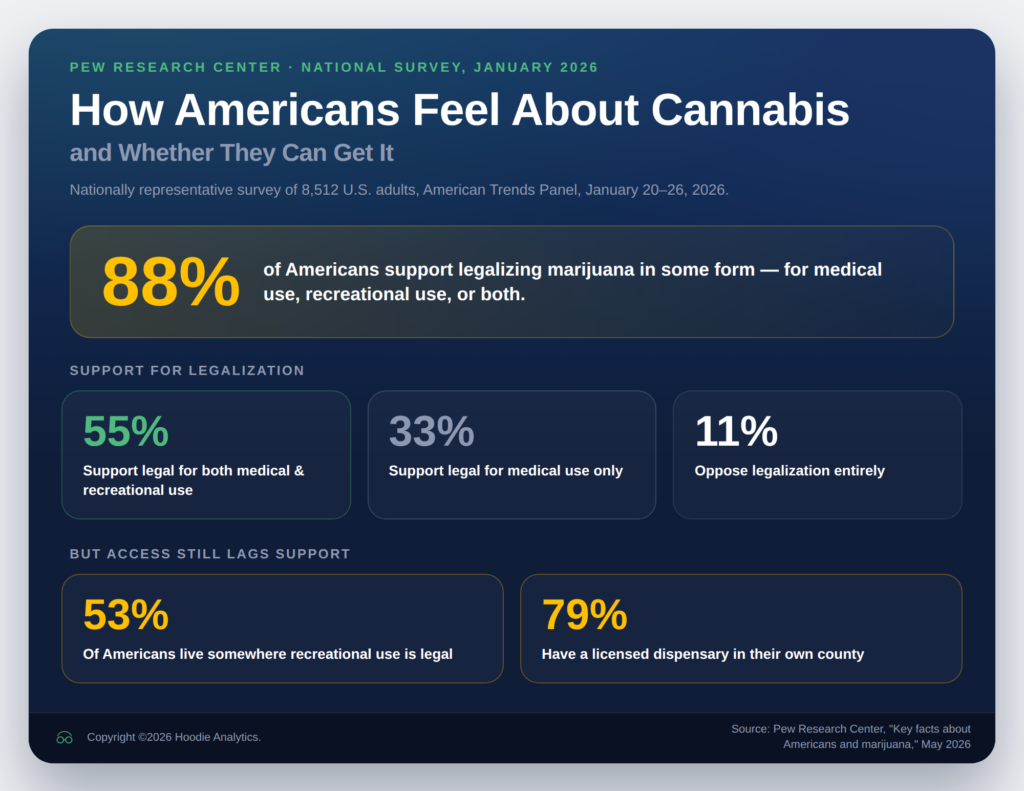
Legal is not the same as available, though. Only fifty-three percent of Americans live in states where recreational cannabis is sold, and only 79% of those people have a licensed dispensary in their own county. That gap, between how people feel about cannabis and whether or not they can actually buy it, isn’t an accident or a rollout delay. It’s a design choice, and it’s baked into almost every state’s legalization framework.
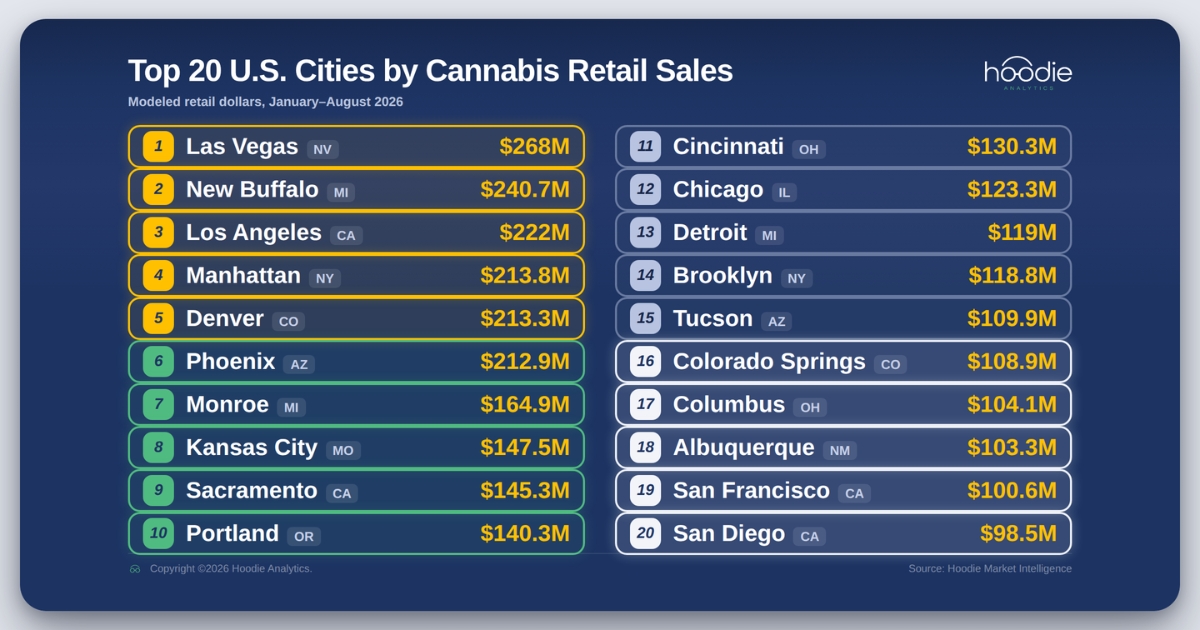
When cannabis is legalized at the state level, there is no guarantee of widespread access for all residents. Most legalization laws hand the real decision of “can this business exist here” down to individual city councils and county boards. The majority of legal states use that power to let local governments ban retail outright rather than just regulate it. That design choice is a huge reason why legal states end up with dense clusters of dispensaries in close proximity to cities that have none at all, no matter how popular legalization was at the ballot box. Of the top twenty cities listed, seventeen of them are in states that have granted local governments this opt-out power.
Here is a map of California illustrating geographically where the volume of sales is happening leveraging market data provided by Hoodie Analytics:
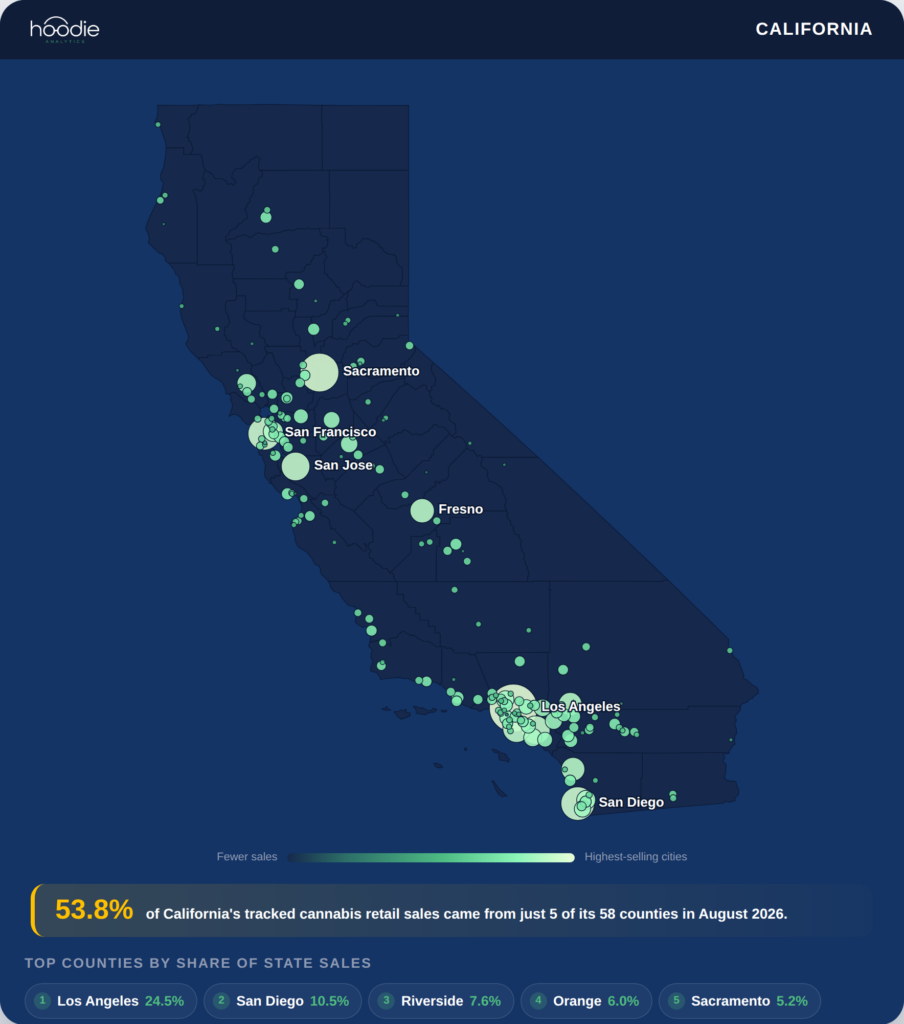
In August of 2026, Los Angeles County alone accounted for roughly a quarter of the entire state’s legal cannabis retail sales. Just five of California’s fifty-eight counties (Los Angeles, San Diego, Riverside, Orange and Sacramento) produced more than half of it. Nine counties, mostly small and rural, recorded zero legal retail sales. California didn’t legalize a retail market spread evenly across a state of nearly forty million people. It handed each of its 58 counties the choice to opt in or out. Unfortunately most of them opted out, leaving a handful of counties to carry almost the entire market.
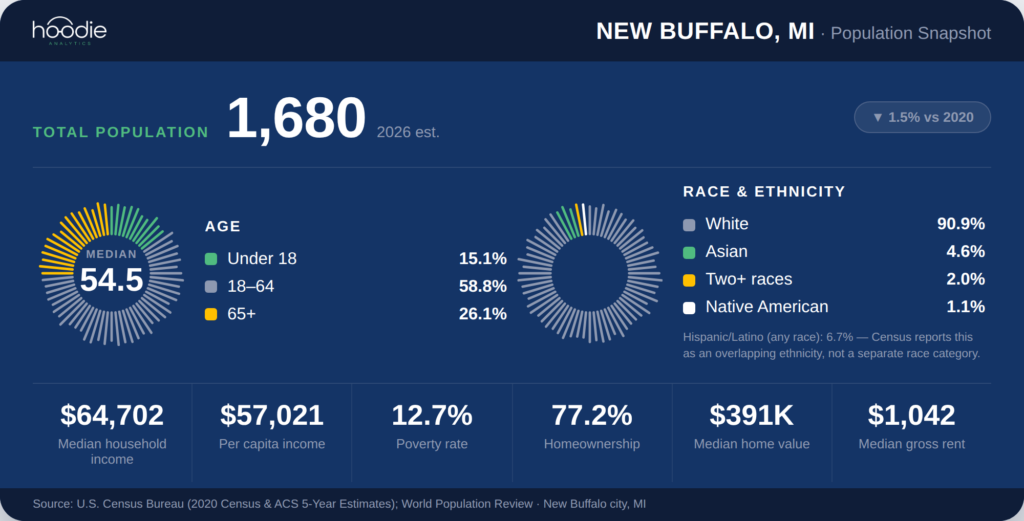
No city makes a better example of how state access shapes markets than New Buffalo, Michigan. It has 1,680 residents, a two-and-a-half-square-mile footprint, and a median age past fifty. It also did roughly $72.4 million in cannabis sales in the first quarter of 2026 alone, which works out to more than $43,000 in quarterly cannabis sales for every single resident. These sales are clearly not only coming from the New Buffalo residents, but likely from Illinois and Indiana. An Indiana paper addressing the phenomenon of sales at the Michigan border gave this city the apt moniker “New Puffalo.”
The drive isn’t always free of consequences once you’re back on the other side of the state line. In Wisconsin this year, a man named Edward Abrams-Phillips was tracked by a network of automated license-place cameras as he crossed into Michigan and back the same day. To be clear, the cameras never recorded him buying anything. Investigators noticed the travel pattern and inferred the rest. The surveillance wasn’t even built for this. He was already being watched over an unrelated bail-jumping case that was later dropped entirely. What he was convicted of, in the end, was simple cannabis possession, for a product that was completely legal to buy an hour away. As cameras get more ubiquitous, these situations will only increase in frequency.
None of this means legalization failed. Eighty-eight percent support isn’t a fluke, and the money moving through New Buffalo and Los Angeles County alike is proof that the demand was always real. What the map actually shows is that America didn’t legalize cannabis so much as it legalized the option to legalize cannabis, county by county, sometimes block by block. This leaves millions of people close enough to a legal market to want one, and just far enough from it to have to make a choice: drive, or don’t. For now, most of the country is still driving.