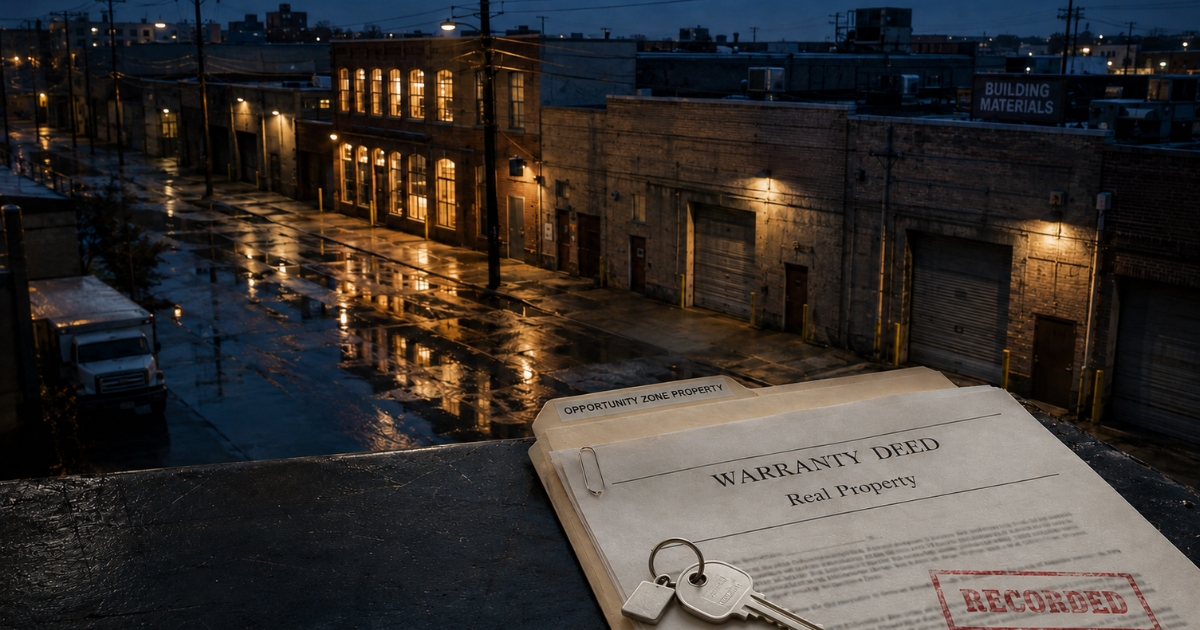
The cannabis industry chased licenses. The real money was under our feet. Now the question is who owns the block before the capital arrives.
THE QUIETEST EARTHQUAKE IN AMERICA
No confetti. No green smoke. No celebrity holding giant scissors over a giant ribbon while cameras flashed.
There was a pen.
On April 23, 2026, the Department of Justice issued a final order moving two things out of Schedule I of the Controlled Substances Act and into Schedule III: marijuana in FDA approved drug products, and marijuana grown, processed and sold under a state medical license. It took effect April 28. Adult use cannabis did not move. It is still Schedule I. A DEA hearing on whether the rest of the plant follows ran from June 29 to July 15, the closing briefs went in on August 17, and the judge’s recommendation is still pending with no timeline attached. The April order itself is being challenged in the D.C. Circuit. So the ground moved, and it is still moving.
Most of America scrolled right past it. But somewhere, in a warehouse district nobody wanted, on a strip of land a city had written off, inside a census tract appraisers treated like a coffee stain on the map, the story about the dirt changed.
For years, the cannabis industry chased the wrong trophy. Operators clawed at each other over licenses. Investors mortgaged their futures for licenses. Lawsuits piled up over licenses. Entire fortunes were wagered on the privilege of holding a piece of paper that said you may legally touch the plant.
And the whole time, the real asset was sitting underneath everyone’s feet: the land.
The April order did not create nationwide legalization. It did something quieter. It made part of the industry legible to money: understandable, financeable and appraisable. Once money can read a thing, money moves toward it. When money moves, development follows. When development follows, ZIP codes change. And the people most likely to be standing outside the new ZIP code are the ones who held the block through prohibition.
So here is the question we should be asking: Did the federal government just help turn medical cannabis from a culture war target into an emerging real estate asset class, one that overlaps with thousands of neighborhoods already marked for redevelopment? And if it did, who is going to own it? Pull up a chair. We are going to follow the dirt.
WHO OWNS THE DIRT BEFORE THE WAVE ARRIVES?
There is a danger in every redevelopment story. Capital arrives, values climb, rents rise and the people who carried a neighborhood through its hardest years get priced out of the recovery they created. Cannabis has watched this movie before. The first legal markets were built by pioneers, patients, activists and legacy operators who took the arrests and the raids so the rest of the country could walk into a dispensary. Then the licensing rush arrived, and a lot of those people ended up as tenants, employees or cautionary tales.
The real estate cycle is about to run the same play, and it will run it faster, because this time the money can read the map.
That is why this cannot be only a story about attracting institutional capital. It has to be a story about ownership. Who owns the storefront? Who owns the warehouse? Who owns the vacant parcel next door? Who receives the appreciation when a forgotten corridor becomes investable? If operators stay tenants while outside capital buys the block, the industry will create wealth without keeping any of it in the communities that absorbed prohibition’s damage.
Legacy operators and local entrepreneurs should be studying deeds, zoning maps, redevelopment plans, infrastructure projects and public incentive boundaries with the same intensity they once studied licensing rules. The rest of this piece is the toolkit for doing that.
YOU WERE WATCHING THE WRONG ASSET
Walk into almost any cannabis conference and listen. Brands. Strains. Genetics. Terpenes. Packaging. Followers. Drops. Products, products, products.
Meanwhile, the quietest person in the room, the one with a leather folio and a calculator app open, is thinking about one thing: location.
Cultivation needs land. Manufacturing needs facilities. Testing needs laboratories. Retail needs storefronts. Media companies need studios. The physical footprint of this plant industry is enormous. It is real estate wearing a cannabis costume.
Real estate has an ancient, unkillable rule. The business inside a building rises and falls, but the building remains. A brand can collapse on Tuesday. The deed does not care. The landlord still collects. Brands rise and fall. Regulations change. Logos get redesigned. Ownership is where wealth quietly piles up while everyone else argues about packaging.
That does not mean every operator should buy every building. Retail property may offer durable location value, while cultivation and manufacturing space can demand flexibility as energy costs, technology and regulation change. Own where the value is long term. Lease where the ground keeps moving.
This is not a new pattern. After alcohol prohibition ended, fortunes were made by names on bottles. A quieter and more durable class of wealth was built by people who owned the warehouses, distribution centers, corridors and transport hubs every legal drink had to cross on its way to a glass. Same script. New plant. The trophy was always under the trophy.
280E AND THE REAL ESTATE CHAIN REACTION
To understand why federal scheduling matters to property, you have to understand Section 280E. For years, cannabis businesses were denied the ordinary deductions other legal companies take for granted. Payroll, rent, insurance, security, utilities and marketing became part of a tax structure capable of making a company look profitable on paper while it bled out in real life.
280E was not merely a tax problem. It was a tourniquet. Crushing tax burdens produced thin profits. Thin profits produced weak valuations. Weak valuations scared lenders. Without affordable capital, development stayed slow, starved and cash heavy.
Here is the part of the April order that has not sunk in yet. 280E only applies to Schedule I and II substances. State medical licensees just left Schedule I. Adult use operators did not. That means a medical license and a recreational license sitting in the same building can now have two different tax lives, and the medical side has a path to DEA registration and ordinary deductions that the rec side is still waiting on. If you run in an adult use state, the judge’s pending recommendation is not abstract policy. It is your P&L.
Any meaningful relief from the 280E chain changes more than a tax return. Cash flow improves. Lenders can lean in. Appraisers get transactions and operating data that make sense. Marginal property begins to pencil. The money watching this is not watching because it loves the culture. Some of it could not name a strain at gunpoint. It is watching because uncertainty is expensive, and markets reprice assets when uncertainty starts to fall.
THE GREEN ZONE THEORY
Now put two maps on the table. One shows cannabis operators already occupying overlooked industrial districts, tired retail corridors and rural properties. The other shows Opportunity Zones and other public redevelopment targets still searching for durable industries.
A quick refresher for anyone who tuned out in 2018. An Opportunity Zone is a low income census tract nominated by a governor and certified by Treasury. An investor who sells an asset can roll the capital gain into a Qualified Opportunity Fund within 180 days and defer the tax for up to five years; hold the investment ten years and the appreciation on it comes out federally tax free. The 2025 tax law made the program permanent and tightened who qualifies. Governors have been nominating a fresh round of tracts since July 1, most lists are due September 28, and the new zones take effect January 1, 2027 and run through 2036. About a third of the 25,000 eligible tracts are entirely rural, and rural funds get triple the basis step up of a standard fund plus a lower rehab threshold. In other words, the new maps are being drawn this month, and the biggest incentives are pointed at exactly the kind of small town and industrial edge property cannabis already occupies.
Here is what cannabis never got to use. The statute bars Opportunity Zone money from a short list of “sin businesses”: liquor stores, golf courses, country clubs, gambling. Cannabis is not on that list. It did not need to be. A fund manager moving capital gains money into a Schedule I business was a conversation most of them refused to have, and their lawyers made sure of it. So, the tracts filled up with self storage and apartments while the cannabis businesses that were actually employing people in those tracts watched from the sidewalk.
Medical Schedule III does not settle that question. It changes the math. A state medical licensee registered with the DEA is, for the first time, a business the federal government has recognized in writing, and that is the kind of sentence a fund’s counsel can put in a memo. Adult use operators are still locked out. Everyone else just got a key they did not have in March, and the doors it opens are being numbered right now.
Where those two maps overlap, I see what I call a Green Zone: not a weed district, but an economic ecosystem with cannabis as an anchor tenant. Think cultivation, testing, research, education, media, compliance, professional services, construction, and healthcare stacked in the same local economy. A Green Zone is an innovation district that happens to have a plant at its center instead of a search engine. Not every Opportunity Zone becomes one, and not every cannabis company creates community wealth. But when capital, compliance, healthcare, entrepreneurship, redevelopment, and community investment align, the gravity is hard to ignore.
Oklahoma offers an early case study. Its licensing boom pushed businesses into empty buildings across industrial districts, dead retail, and rural towns. The market was chaotic, but it did something economic development agencies spend careers trying to do: it put businesses into buildings nobody else wanted. As weaker operators wash out and stronger ones combine, the market moves from a licensing rush to an infrastructure phase. That is where patient capital lives.
The next opportunities may not be in the markets with the loudest headlines. Pennsylvania brings medical market maturity and density. Florida brings population growth and healthcare infrastructure. Texas remains a political question mark sitting on top of enormous freight, real estate and population scale. Kentucky, Alabama, Mississippi, Louisiana, West Virginia and Arkansas offer combinations of lower cost land, industrial history and early infrastructure. The first wave took the arrows. The second wave may take the territory.
YOU DO NOT HAVE TO TOUCH THE PLANT
One misconception has cost ordinary entrepreneurs millions: that every cannabis opportunity requires touching cannabis. It does not.
Architects, engineers, contractors, security firms, insurers, laboratories, software companies, marketers, educators, packaging suppliers, accountants, and attorneys can ride the industry’s growth while carrying a fraction of its regulatory weight. Some will prove to be stronger businesses than the plant touching companies they serve.
Look at it from the block’s point of view. Every dollar an operator spends on build out, security, testing and legal work is a dollar that either stays in the neighborhood or leaves on the next flight home. Local ownership of the ancillary layer is how a Green Zone keeps its own money.
Information belongs on that list. As an industry matures, media, education, data and research become load bearing infrastructure. They are not sideshows. They teach operators, document the culture, explain the law, track the money and challenge the institutions entering the market. The people who own the facilities beneath that infrastructure own a piece of every story the industry talks about itself.
THE APPRAISAL PROBLEM
For years, valuing cannabis real estate meant working through thin comparable sales, cash heavy transactions and regulatory risk that hung over every conclusion. An asset that cannot be valued confidently trades inside a small, nervous buyer pool. A small buyer pool suppresses price, not always because the property is bad, but because the property is illegible.
As legal and financial uncertainty falls, the pool can widen from cannabis only buyers to mainstream real estate capital. Appraisers sit at the pressure point between markets and money. In a young industry, they do not simply measure value; their work helps define what lenders and buyers are willing to recognize. A surprising part of cannabis’s future will be decided inside appraisal reports the public will never read.
But operators should not confuse a rising tide with guaranteed value. A property should be tested for alternative use, zoning durability, energy demand, environmental conditions, access, market rent and the cost of conversion. The cannabis premium can disappear when a license disappears. The underlying real estate must still make sense.
GRADUATION DAY
Cities should count cannabis businesses as employers and taxpayers when they decide which neighborhoods deserve investment. Community groups should negotiate for pathways to ownership, not only short term jobs. And operators should get to the county recorder’s office before the fund managers do.
The first cannabis economy was built by people who took risks. The next one will be built by developers, lenders, appraisers and funds. Every industry eventually graduates from rebellion to infrastructure. Cannabis is in the middle of that graduation, and graduations are where some people receive diplomas while others receive the bill.
The license matters. The brand matters. The product matters. But when the market contracts, regulations shift or capital finally arrives, the deed may be the one asset that remains.
I came for the plant. I stayed for the economics. Now I am following the dirt.

ORIGINAL PUBLICATION NOTE
This article was adapted from “I Came for the Deed: The Green Zone Files,” originally published by Pressure News Media in its August September 2026 Banker’s Cut issue. © 2026 Thunder Walker / Pressure News Media. Offered for nonexclusive republication by written agreement; all other rights reserved.