Key Takeaways
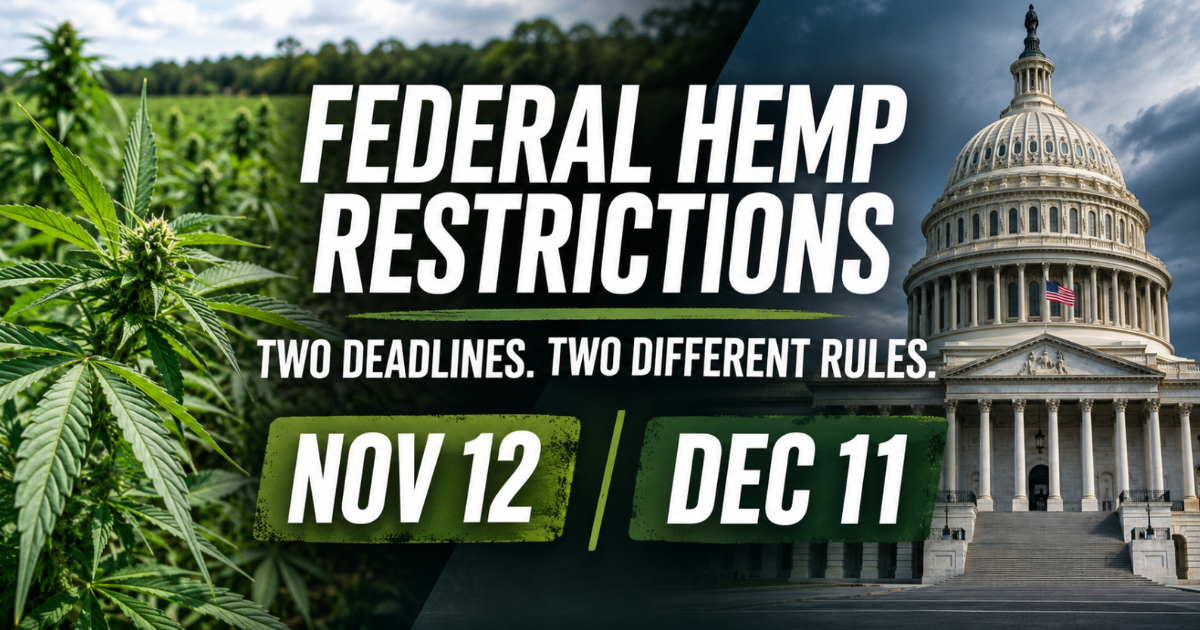
- Today marks the first live piece of the federal hemp definition overhaul, though full implementation will be delayed until December 11, 2026.
- Effective immediately, products containing cannabinoids not naturally produced by cannabis plants lose federal hemp status, with THC-O being a key example.
- The December 11 deadline introduces broader provisions, such as a total THC standard and regulations for hemp-derived products, crucial for the industry.
- Businesses must differentiate between today’s exclusion and the upcoming December provisions, ensuring compliance with both federal and state laws.
- The FDA has yet to publish required cannabinoid lists, leading to uncertainty in product classifications before the December rules take effect.
Today marks the first live piece of a federal hemp definition overhaul that has been a year in the making. Under Public Law 119-37, enacted November 12, 2025, Congress rewrote the hemp definition found in 7 U.S.C. 1639o. The law was originally set to take full effect on its one-year anniversary: today, November 12th.
That didn’t happen in full. In September, President Trump signed H.R. 6500, the Continuing Appropriations and Extensions Act, 2027, which pushed most of the new definition’s provisions back to December 11, 2026. The House passed that delay 370 to 48, and the Senate followed with a 90 to 6 vote.
One exclusion was carved out of the delay. Starting today, intermediate and final hemp-derived cannabinoid products containing cannabinoids that are “not capable of being naturally produced” by a cannabis plant lose their federal hemp status. The Congressional Research Service points to THC-O as the clearest example: a cannabinoid that doesn’t occur naturally in the plant and is instead made by converting cannabis-derived CBD into delta-8 THC, then treating it with acetic anhydride.
According to the CRS Legal Sidebar published October 28th (LSB11496), products meeting that description “will not be classified as hemp, and will be treated as controlled substances” to the extent they fall under the Controlled Substances Act’s definition of marijuana or THC.
Why Does the December 11 Deadline Matter Separately?
Treating November 12 and December 11 as the same deadline is the most common mistake businesses are likely to make this month, and it’s an understandable one given how close the dates sit together. They are not the same event.
The provisions scheduled for December 11 are broader and, for most of the hemp industry, more consequential. According to CRS, that date brings:
- A total THC standard of no more than 0.3%, measured on a dry-weight basis and including THCA, replacing the current delta-9-only test. This change is what closes what’s commonly called the THC loophole, since it captures delta-8, delta-10, and THC-O regardless of how they were derived.
- A cap of 0.4 milligrams of combined total THC and similar cannabinoids per container for final hemp-derived products, with “container” defined as the innermost packaging in direct contact with the product at retail.
- Exclusions for cannabinoids that occur naturally in the plant but were synthesized or manufactured outside of it, along with intermediate products exceeding the 0.3% total THC threshold.
Beard Bros Pharms covered the original version of this redefinition back when it first threatened to upend products legalized under the 2018 Farm Bill. The core math hasn’t changed; only the calendar has.
Has FDA Published the Cannabinoid Lists Congress Required?
Not as of the most recent reporting. Public Law 119-37 directed the FDA to publish, within 90 days of enactment, three cannabinoid lists and additional guidance on what counts as a “container.” Those lists were due by February 2026.
The CRS Legal Sidebar dated October 28, 2026 states plainly: “As of the date of the publication of this Legal Sidebar, FDA has not published any of these items.” That reporting is now two weeks old as of today, and neither CRS nor The Marijuana Herald, which first reported the finding on October 29, has offered an explanation from the agency for the delay.
The missing lists don’t stop today’s exclusion from taking effect. But they do leave open questions about how edge-case cannabinoids and ambiguous packaging formats will eventually be classified once the December 11 provisions arrive. Businesses relying on a published FDA list to settle gray-area product questions are, for now, out of luck.
Why Does the Distinction Between the Two Dates Matter for Hemp Businesses?
Manufacturers and retailers who conflate the two deadlines risk reacting to the wrong rule on the wrong day, or worse, assuming they have until December 11 to address a problem that’s already live today.
Products built around cannabinoids that can’t be naturally produced in the plant, the THC-O example CRS cites being the clearest case, are the ones affected as of today. Everything else, including the measurement standard most of the hemp beverage and edibles market has been bracing for, still has a month of runway before December 11.
There’s also a state-law layer sitting on top of the federal timeline. We have tracked how states set their own schedules independent of Congress. Illinois fixed its own alignment date at November 12, 2026, matching today’s federal change. Missouri ties its rule to the federal effective date generally. Rhode Island adopts the federal definition on December 11 with no transition period. Minnesota has said it intends to keep regulating hemp-derived products under its own framework regardless of what Congress does federally, though products falling outside the federal definition still lose access to lawful interstate commerce.
That patchwork means a product compliant under today’s federal exclusion could still run into a separate state restriction with its own effective date.
Is This Exclusion Actually Resolving a Legal Fight Over Synthetic Cannabinoids?
In a sense, yes. CRS describes products made from cannabinoids that don’t occur naturally in cannabis as having been “the subject of two contradictory conclusions regarding their legal status” for several years now.
The DEA has consistently treated synthetic THC as a controlled substance. In an August 2020 interim final rule, the agency said the 2018 Farm Bill “does not impact the control status of synthetically derived” THC. A February 2023 DEA opinion letter went further, concluding THC-O is a Schedule I substance because it “can only be obtained synthetically.”
Courts have disagreed. In Anderson v. Diamondback Investment Group, decided September 4, 2024, the Fourth Circuit held that THC-O products qualified as hemp under the 2018 Farm Bill’s language, reasoning that the statute covers all cannabinoids and derivatives from the cannabis plant that stay under the 0.3% delta-9 THC limit, regardless of how those cannabinoids were produced.
Today’s exclusion writes the “naturally produced” test directly into the statute, which CRS suggests may settle that disagreement, at least for the specific category of products it covers. It doesn’t resolve every question about enforcement, and CRS has separately noted it remains unclear exactly how federal agencies will enforce the new standard in practice.
What Should Hemp Businesses Do Between Now and December 11?
This isn’t legal advice, and any business navigating these overlapping deadlines should talk to counsel familiar with both the federal statute and their specific state’s rules. That said, the general shape of the preparation work is consistent across the hemp sector right now.
Businesses need to know their numbers: total THC content including THCA and delta-8, not just delta-9. They need to confirm whether their products rely on cannabinoids that occur naturally in the plant or ones that require synthetic conversion, since that distinction is exactly what’s driving today’s exclusion. Keeping current certificates of analysis, formulation records, and labeling documentation on hand will matter more as December 11 approaches and the total-THC standard replaces the narrower delta-9 test.
Payment processors and banking partners are also watching this space closely, and sudden account closures tied to compliance uncertainty aren’t unheard of in this industry. We have written about how these federal shifts intersect with market consolidation pressure, which is worth understanding for anyone trying to plan more than a month ahead.
What Happens if Congress Delays the Hemp Rules Again?
It’s not off the table. Several bills are sitting in committee that would either delay the new definition further or repeal it outright. H.R. 7024, H.R. 7010, and S. 3686 would each push the definition back by two more years. H.R. 6209 would repeal the changes from Public Law 119-37 entirely.
On the other side, the House-passed FY2027 Agriculture appropriations bill contains no additional delay, suggesting at least one chamber isn’t inclined to push the timeline further right now. Industry groups have pegged the hemp-derived cannabinoid market at roughly $28 billion annually, supporting an estimated 300,000 jobs, according to figures when the September delay passed. Those are industry estimates, not government figures, but they explain why this fight keeps resurfacing in every funding bill that moves through Congress.
Thirty five state attorneys general urged Congress to reject further delay and let the restrictions take effect on schedule, a position that puts them at odds with much of the hemp industry, which has pushed for FDA regulation instead of a near-total ban on synthesized cannabinoids.
Where This Leaves Hemp Businesses Right Now
Today’s change is real, but it’s narrow. It targets cannabinoids the plant cannot make on its own, with THC-O as the clearest example CRS has offered. The provisions most of the industry has been bracing for, the total-THC standard and the 0.4 mg per-container cap, still have a month on the clock before December 11.
That month matters. FDA’s required cannabinoid lists remain unpublished as of the most recent CRS reporting, state rules are running on their own separate calendars, and Congress still has live bills that could shift the December date yet again. Businesses that treat today as the whole story, rather than the first half of it, are the ones most likely to get caught off guard next month.
Frequently Asked Questions
Not in full. Today marks the start of one specific exclusion under the new federal hemp definition: products containing cannabinoids that cannot be naturally produced by the cannabis plant, such as THC-O, lose federal hemp status today. The broader total-THC standard and the 0.4 mg per-container cap remain scheduled for December 11, 2026.
As of today, intermediate and final hemp-derived cannabinoid products containing cannabinoids “not capable of being naturally produced” by the plant are excluded from the legal hemp definition and may be treated as controlled substances under the Controlled Substances Act.
Delta-8 THC itself occurs naturally in trace amounts in cannabis, but products containing it will need to comply with the new total THC standard taking effect December 11, which measures total THC including THCA and delta-8 on a dry-weight basis, capped at 0.3%. Products exceeding that threshold, or the 0.4 mg per-container limit, would fall outside the hemp definition.
It’s a cap, scheduled to take effect December 11, 2026, limiting final hemp-derived cannabinoid products to no more than 0.4 milligrams of combined total THC and similar cannabinoids per container. CRS defines “container” as the innermost packaging in direct contact with the product at retail.
It’s possible. Several bills, including H.R. 7024, H.R. 7010, and S. 3686, would delay the new definition by two more years, and H.R. 6209 would repeal it outright. None had passed as of this writing, and the House-passed FY2027 Agriculture appropriations bill currently contains no further delay.