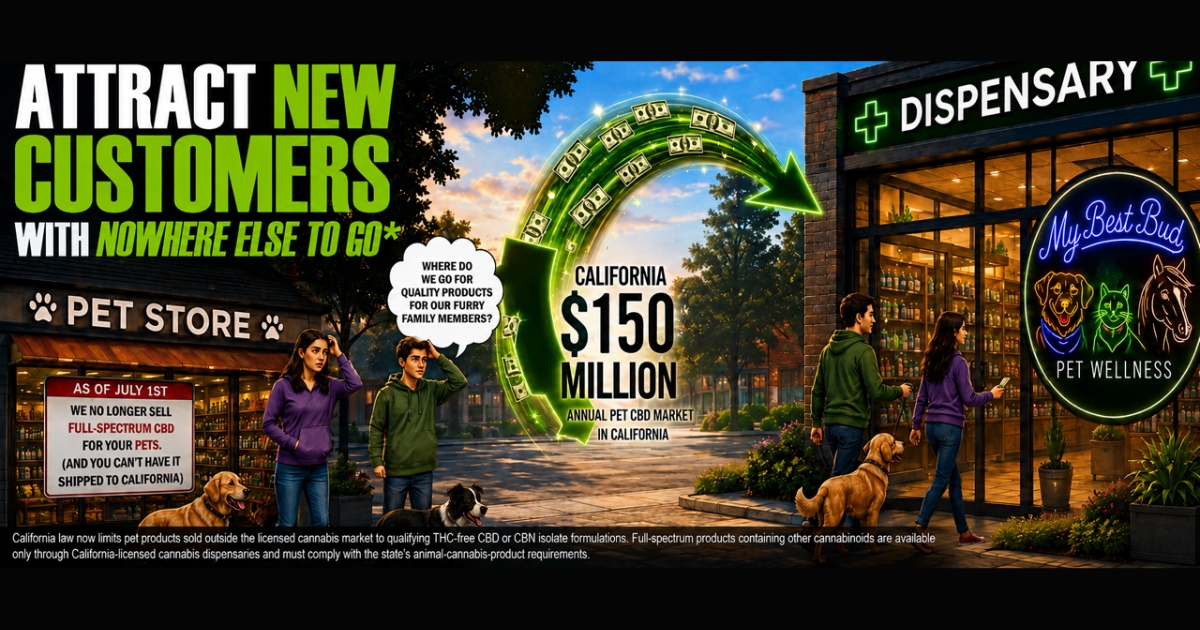
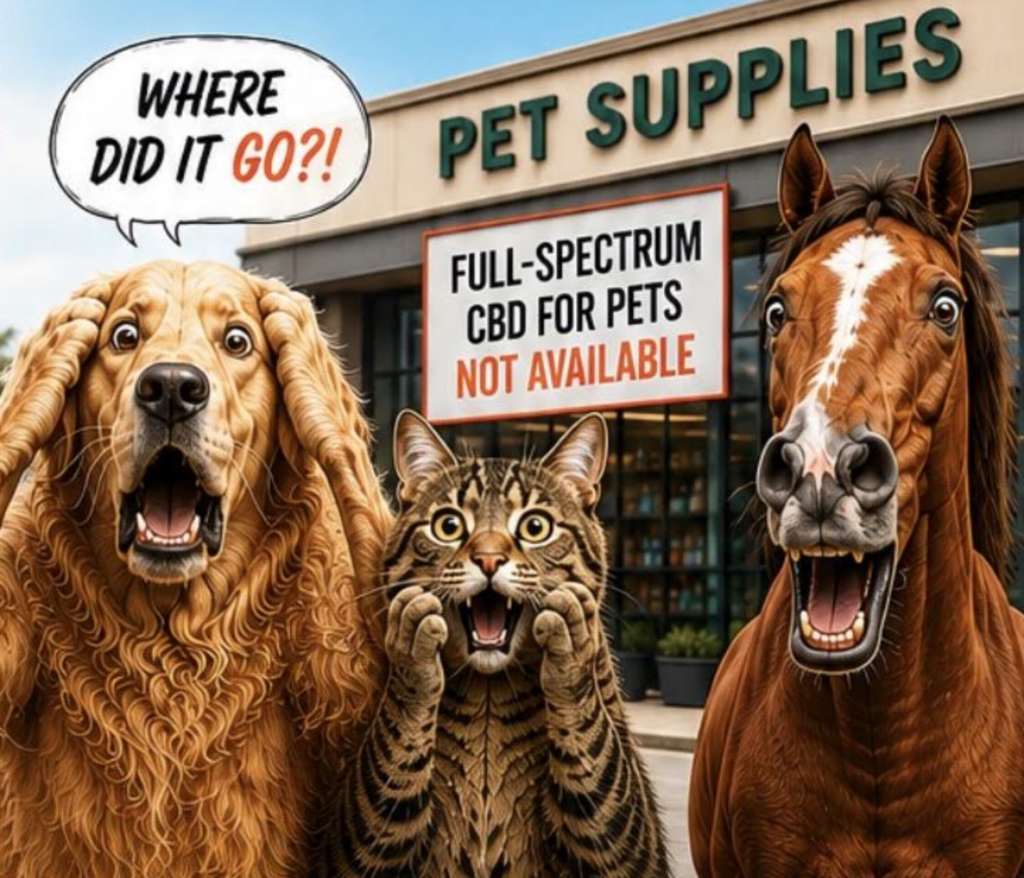
Not one of them has ever set foot in a licensed cannabis store. They have been buying full spectrum CBD for their animals for years, from pet stores and from websites. On July 1st both loopholes were closed and these new customers who need a refill every thirty days for their beloved animals, are shopping for a store right now.
This article contains legal information with citations to the governing statutes and regulations. This is not legal advice, and I am not your lawyer.
The simplest way to understand this
Picture the customers who walked into your store last Saturday.
Now picture a second group, roughly the same size, spread across the same neighborhoods, who have never once stood in that line. They do not smoke. Many of them have never been in a licensed cannabis store in their lives and never expected to be. They are pet owners, and for years they have bought a full spectrum CBD product for a dog or a cat at a pet boutique, a feed store, a chain retailer or a website.
This year that product disappeared from every one of those places, in two moves, six months apart, by operation of state law.
Those buyers are not going to give up. Their animals are old, arthritic, anxious, epileptic or recovering from surgery, and the product has been working. They are going to go looking.
There is now exactly one kind of business in California that can lawfully sell to them, which narrows their options to two: your store, or the licensed store closest to yours. That is the entire competitive situation. This is not a fight over market share with a hemp brand or a pet chain. Those competitors are gone. The only party who can take this revenue from you is another dispensary.
And these buyers will not shop around for long. People who dose an animal every day are people who settle into a routine. They will find one store that carries the product, answers their questions and does not make them feel stupid at the counter, and then they will refill there twelve times a year for as long as the animal is alive. The first store to get it right keeps them.
Every one of these customers is going to end up somewhere. The only question in front of you is whose menu they are standing at when they do.
Two statutes, one year, and a market with nowhere left to go
Here is what happened, in four lines.
- January 1, 2026, the hemp side. AB 8 (Ch. 248, Stats. 2025) amended the Sherman Food, Drug, and Cosmetic Law to require that industrial hemp extract used in food, beverages, dietary supplements and processed pet food consist of CBD or CBN isolate at greater than 99 percent purity, with no THC and no synthetic cannabinoids (Health & Saf. Code §§ 111921.1, 113091). Every multi-cannabinoid pet product in the state, full spectrum and broad spectrum alike, became ineligible for the pet store, the feed store and the grocery aisle.
- January 1, 2026, the licensed cannabis side. On the very same day, the Department of Cannabis Control’s animal cannabis regulations took effect, implementing AB 1885 (Ch. 389, Stats. 2022). Until that morning, Business and Professions Code § 26130(e)(2) flatly prohibited marketing or selling any cannabis product for use on, or consumption by, an animal. California now has a licensed animal category for the first time in its history.
- July 1, 2026, the back door. SB 378 (Ch. 411, Stats. 2025) placed verification duties, warning duties and civil liability on online marketplaces hosting unlicensed cannabis and intoxicating hemp listings. The workaround was closed.
- Net effect. Roughly $150 million a year in California pet wellness spending, on a thirty-day refill cycle, with one lawful channel left to absorb it.
Two statutory schemes, two agencies, one displaced group of buyers. Nothing crosses over from the hemp side onto your shelf. The inventory does not move, and neither do the companies that made it. What moves is the customer.
These are not dispensary customers. They have never been in your building.
This is the part I want to be unmistakable, because everything else follows from it.
Not one dollar of that $150 million has ever been spent in a licensed California store. These buyers were never counted in your sales data, never in your loyalty program, never on your email list, never in anyone’s dispensary foot traffic numbers. They bought pet CBD in a completely separate retail universe that had nothing to do with cannabis retail, and now that universe is gone.
Which also means every one of them is a first-time dispensary visitor. They do not know your menu, your check-in process, your ID rules or your delivery options. They have questions, and some of them are nervous about walking in at all. More on that below, because how you handle the first ninety seconds decides whether they come back.
And be careful about the pet numbers you already have. The category you might be referencing was non-existent and the revenue you might be remembering has nothing to do with the current state of the market. Until January 1 of this year, no cannabis product in California could be marketed or sold for an animal at all. Whatever pet product moved off your shelf before that date was never sold into a regulated animal category, because there was no such category, and it was almost certainly bought by someone who was already standing in your store for another reason.
You have seen this before, and most of the state got it wrong the first time
Ask anyone who wrote off beverages.
Drinks sat at about one percent of dispensary sales for years, and buyers passed using exactly the reasoning I am hearing now about pets: we tried it, it did not move. Beverages went on to post the fastest percentage growth of any category in 2025, and they are a standard fixture in any well merchandised California store today. The operators who made room early own those customers.
Now put the two numbers side by side. California’s entire cannabis beverage category runs somewhere around $80 million a year. The displaced pet demand is roughly $150 million, nearly double the category this whole state is currently rearranging shelves to accommodate.
And here is where the comparison stops flattering beverages and starts flattering you.
Beverages made you finance the adoption curve. Somebody had to persuade flower consumers to drink instead of smoke, one skeptic at a time, over years, out of your own inventory.
This category has no adoption curve. These customers are already sold. They have been dosing their animals every day for years. Nobody has to convince them of anything. They need your address.
What they lost was hemp. What is waiting for them is cannabis.
This is the part I would like our industry to say out loud more often.
Hemp was never the better plant. It was the legal workaround for a market that was not permitted to sell cannabis. For seven years the pet category ran on material selected for fiber and seed, bred to stay under a federal THC threshold, moving through a supply chain with no potency testing mandate, no track and trace and no state laboratory standard.
The published analysis is not kind. A study of 202 commercially available CBD products found that 26 percent did not even meet the product type definition claimed on the packaging, and that 74 percent deviated from labeled CBD potency by at least ten percent. Heavy metals were detected 52 times across 44 products. Residual solvents turned up 446 times across 181 products.
A certificate of analysis did not protect these buyers, because nothing in that channel required the laboratory issuing it to be licensed by anybody.
Now look at what they are about to be handed instead. Animal cannabis products carry the same requirements as products made for human consumption, with two additions written specifically for animals. No more than 1 milligram of total THC per package, against 100 milligrams for an adult edible. Three formats only, being edibles, orally consumed liquids and topicals. No vapes, no flower and no pre rolls for animals, ever. There is no cap on CBD. Everything is tested by a state licensed laboratory and tracked from manufacture to sale under the animal product category (Cal. Code Regs., tit. 4, §§ 15000, 17304).
They are walking in braced for a compromise. What they are going to get is an upgrade, and they are going to notice. When the product you sold them outperforms the one they were loyal to for years, they do not become your pet customers. They become your customers, and the dog park hears about it by the weekend.
You are not adding a SKU. You are adding a door.
Think about who is standing at your counter when these people arrive.
They are curious adults who have never had a reason to come inside, have never been walked through a menu, and are now in the building with a budtender who has their complete attention, because the subject is their animal.
A meaningful share of those visits will produce a second purchase, for the owner and not the animal. Those are customers you acquired through the pet shelf and then keep for everything else, and they come back twelve times a year on a refill schedule they are already disciplined about, because it is not for them.
Whatever a new customer is worth to your store, they are worth it on top of the pet sale, not instead of it. And if the store down the road stocks the category first, that is the door they walk through, and everything behind it goes with them.
The six questions they will ask at your counter, and the answers
First time visitors arrive with the same handful of questions, every time. They are all answerable, and the store that answers them well is the store they come back to.
Why do I need ID for a product for my dog? Animal cannabis products may be made available only through the adult use market, to purchasers 21 and over (Bus. & Prof. Code § 26001(a)). The age rule applies to the human, not the animal. There is no way around this one.
What happens to my license when I hand it over? This question matters far more than most operators realize, because these people have never done this before, and this is the moment they are most likely to turn around and leave. It is an age check, not a registration. Track and trace follows the product, not the purchaser. A licensed retailer may not disclose personal information to a third party without consent, and may not refuse service because a customer withheld it (Bus. & Prof. Code § 26161.5). They can ask you to check the ID by eye rather than scanning it. Train your staff to offer that before they have to ask.
Is any THC safe for my dog? That is a conversation for their veterinarian, who is now free to have it. What the state has decided is a cap of 1 milligram of total THC per package, a fraction of an adult product, because current research does not support high THC products for animals.
My pet store still has CBD on the shelf. Is that the same thing? No. What survives in general retail is a single compound, CBD or CBN isolate at better than 99 percent purity. Full spectrum means multiple cannabinoids present together with the plant’s terpenes, and the interaction among those compounds is what the literature calls the entourage effect (Russo, British Journal of Pharmacology, 2011;163(7):1344). By definition it requires more than one compound to be there. And while we are here, because it comes up constantly: hemp seed oil is not CBD. It is pressed from the seed, it contains essentially no cannabinoids, and it is a perfectly good oil that is not what they were buying.
Can I still just order it online? Cannabis cannot be mailed to a California address, and the full spectrum hemp product they used to order is no longer lawful for sale in this state, which is why those sites stopped shipping here. Licensed delivery is a different animal, and many retailers do it well. It is the single best answer you can give someone who is not ready to walk in the first time.
Do I need a medical card? No. Adult use market, 21 and over, valid ID.
Do you carry a compliant pet wellness product you can advertise to attract your share of the new pet parent customers?
This is the operational question, and it is the one that decides whether any of the above reaches you.
These customers are not going to find you by browsing a menu, because they do not browse menus. They are going to search for a store that carries an animal product, or see it in an email, on a shelf talker, on your social feed or at a rescue event. Which means the asset you actually need is the ability to say publicly, in writing, that you carry a compliant animal cannabis product. If you cannot make that claim, you are invisible to this entire group of buyers, and the store that can make it is not.
Making the claim requires a product that supports it. Under the animal standard that means built to 1 milligram of total THC per package, in one of the three permitted formats, manufactured, tested, distributed and tracked entirely inside the licensed cannabis system, and reported in track and trace under the animal product category. A product that arrived through the hemp channel cannot support the claim, no matter what the label says.
That is the standard we built to. My Best Bud is the first patented pet wellness brand formulated to the DCC animal standard, built to that standard before it took effect. I should say plainly that I run this company, so weigh the paragraphs above accordingly.
At 1 milligram of total THC, an animal product has nothing to rely on except its formulation. We treat every cannabinoid and every terpene as a separately measured active ingredient in a defined terpene to cannabinoid ratio, in a lipophilic carrier, delivered oromucosally. Same inputs, same target profile, batch after batch. We have been working on that problem since our first formulation in 2014.
The approach is protected. It is the subject of two issued United States patents, with thirteen further applications pending to date. The issued claims cover cannabinoid and terpenoid compositions, defined terpene to cannabinoid ratios, lipophilic carriers, methods of treatment and methods of delivery. The patent numbers are printed on the packaging, and anyone who wants to read the claims can pull them from there.
Reproducibility is the reason for all of it, because nothing can be learned from a product that performs differently every batch. Every product feeds a longitudinal outcomes database built from real animal cases, which is itself the subject of a pending application and which drives the formulation work. That database exists because of a principle called One Health. Companion animals develop the same cancers, the same arthritis and the same neurological disease as the people who love them, and veterinary research reaches endpoints sooner than human trials do. When an owner tells us how an animal did, that observation is meant to move cannabinoid medicine forward for both species.
A company built to generate usable data has to be built differently than a product built to be sold.
Distributed statewide through Nabis. Order through the Nabis Marketplace or email sales@hyroad.com.
This is the first in a series
There is a great deal more to say here than fits in one article, and most of it is more interesting than shelf space.
Over the coming months this series will cover the science of cannabinoid and terpenoid formulation and why ratios matter more than milligrams, what the veterinary research actually shows and where it falls short, how animal data can accelerate human medicine under the One Health model, and what is moving in Sacramento. Send me your questions and your comments and I will try to work them into what comes next.
Stock the category. Serve the customer. Join us. Learn more about compliant patented pet wellness products at MyBestBudCA.com.
Notes
California regulates industrial hemp and licensed cannabis under two separate statutory schemes. A rule governing hemp in general retail says nothing about what a licensed dispensary may sell, and the reverse is equally true.
1. The $150 million figure. No published study isolates this market, so the estimate is built from the bottom up and stated conservatively. The AVMA puts the 2025 United States pet dog population at 87.3 million. California’s share of households is roughly ten percent and its pet ownership rate runs below the national average, which supports approximately 8 million California dogs. The Dog Aging Project, the largest study of its kind at 47,355 dogs surveyed between 2019 and 2023, found that 7.3 percent of companion dogs have been given CBD or hemp products, with usage highest in cannabis friendly states, yielding roughly 584,000 California dogs. Because “have been given” overstates current use, only half that population is counted as active purchasers, approximately 292,000. At a thirty day refill and $50 per bottle, the low end of retail pricing, that is $600 per animal per year, or $175 million for dogs. Adding cats at approximately twenty percent of category volume brings the total to $210 million. Applying the multi-cannabinoid share of roughly 72 percent yields approximately $151 million. Every alternative assumption produces a larger number: at sixty percent active purchasers, $182 million; at $60 per bottle, $182 million; at both, $218 million. Published top down estimates of the entire United States pet CBD market run lower, from $300 million (Mordor Intelligence, 2025) to $576 million (Straits Research, 2026), but those studies are widely understood to undercount direct to consumer and independent specialty retail, which is precisely where this category lived. Treat $150 million as an order of magnitude floor. Note also that this describes displaced hemp channel spending. It is not a projection of licensed cannabis sales.
2. The beverage comparison. BDSA reports that cannabis beverages have historically sat at approximately one percent of total dispensary sales, with growth long constrained by formulation, distribution and in store merchandising. Beverages posted the fastest percentage growth of any category in 2025, at fifteen percent year over year in Q1. California’s beverage category represents roughly two percent of the state’s approximately $4.4 billion in licensed retail sales, or about $88 million annually, referred to in the text as $80 million.
3. Label accuracy in retail CBD. A published analysis of 202 commercially available CBD products (100 tinctures, 48 gummies, 34 vape products, 20 topicals) found that 26 percent did not meet the product type definition claimed on the packaging and that 74 percent deviated from labeled CBD potency by at least ten percent. Heavy metals were detected 52 times across 44 products, residual solvents 446 times across 181 products, and pesticides 55 times across 30 products. These were hemp channel products, sold without the mandatory laboratory testing that applies to licensed cannabis in California.
4. Why hemp inventory cannot cross over. A licensed dispensary may sell an animal cannabis product only if it was lawfully manufactured, tested, distributed, transferred and tracked inside California’s regulated cannabis system. AB 45 expressly does not apply to cannabis, and AB 8 restricts licensed cannabis manufacturers to concentrates and extracts processed from cannabis obtained from licensed cultivators until January 1, 2028. A former hemp product does not become dispensary inventory because it contains CBD or was previously marketed for pets.
5. The animal cannabis product standard. Animal cannabis products are subject to the same requirements as products intended for human consumption, except that they may contain no more than 1 milligram of total THC per package and are limited to edible cannabis products, orally consumed concentrates and topical cannabis products as defined in Cal. Code Regs., tit. 4, § 15000. “Total THC” is the sum of THC, delta-8 THC and THCA. The human edible limit is 100 milligrams per package (tit. 4, § 17304). There is no potency restriction on CBD or other non-THC cannabinoids. Licensees must report the product in track and trace under the animal product item category, update a product quality plan (tit. 4, § 17214) and master manufacturing protocol (tit. 4, § 17215), and comply with existing packaging and labeling requirements. Food animals (Bus. & Prof. Code § 4825.1) and livestock (Food & Agric. Code § 14205) are excluded. Dogs, cats, horses and pet birds are not.
Irena Raskin is the founder and CEO of My Best Bud and a licensed California attorney. This article is written in her capacity as a brand operator. It provides legal information, not legal advice, and does not create an attorney client relationship. Readers should confirm current Department of Cannabis Control and California Department of Public Health guidance and consult their own counsel before making compliance decisions.