Key Takeaways
- UC Davis researchers have deconstructed LSD’s complex structure to isolate effects like hallucinations and cardio risks, aiming for safer psychedelic derivatives.
- They created two promising compounds, UCD0094 and UCD0076, which show improved safety profiles without inducing hallucinations.
- UCD0076 specifically targets the 5-HT2C receptor, displaying potential antipsychotic effects while minimizing side effects associated with LSD.
- This research paves the way for new treatments for conditions like schizophrenia, epilepsy, and substance use disorders, separating therapeutic effects from hallucinations.
- The study illustrates a shift in psychedelic medicine towards precise drug design, focusing on molecular features rather than broad effects.
LSD has been studied for over 80 years, yet chemists have never fully understood how its molecular structure produces such a specific mix of effects. A team at UC Davis decided to find out by taking the molecule apart piece by piece. Their study, published in PNAS, systematically deconstructed LSD’s core structure to identify exactly which components drive hallucinations, which ones create cardiac risk, and which might hold real therapeutic value on their own.
The research was led by David E. Olson, director of UC Davis’s Institute for Psychedelics and Neurotherapeutics and a professor of chemistry and biochemistry and molecular medicine. His team’s approach treated LSD less like a sacred molecule and more like an engineering problem. That mindset produced two standout compounds, UCD0094 and UCD0076, both of which showed improved safety profiles compared to LSD itself.
The findings matter beyond pure chemistry. Psychedelic medicine’s next chapter may not be about giving everybody psychedelics. It may be about learning which molecular features create neuroplasticity or therapeutic activity and separating those from hallucinations or cardiovascular liabilities. A compound that captures useful biology without requiring an eight-hour altered state is a very different product, medically and commercially.
What Is LSD’s Molecular Structure, and Why Has It Been So Hard to Modify?
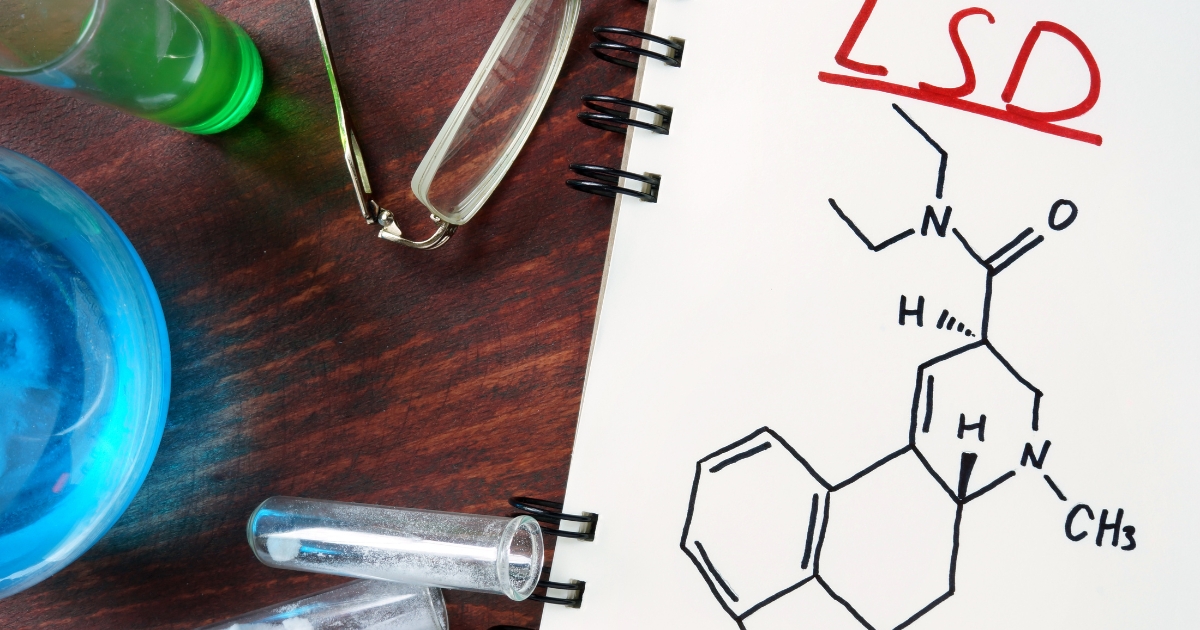
LSD’s core is called the ergoline scaffold, a rigid structure made of four fused rings. According to the study published in PNAS, this tetracyclic architecture has limited how much scientists can safely modify without losing the molecule’s activity altogether. Olson put it plainly: “We’ve known the structure of LSD for a long time, but the complexity of its core has really limited our ability to engineer optimized drugs based on its structure. If you can only modify a couple of spots, you’re limited in what you can do.”
Part of what makes LSD’s molecular structure so unusual is that it behaves like a hybrid. Olson describes it as a blend of two major psychedelic families: the tryptamine family, which includes psilocybin and DMT, and the phenethylamine family, which includes mescaline and MDMA. “If you take those structures and overlap them, they basically produce LSD,” Olson said. “The big question is, which one of those is more important for the hallucinogenic effects of LSD?”
That question sat unanswered for decades because nobody had a practical way to isolate the two influences. Most prior LSD analogues, including known compounds like lisuride, only tweaked the outer edges of the molecule rather than its core architecture. The ergoline scaffold’s complexity made deeper structural changes both synthetically difficult and scientifically risky.
How Did Researchers Deconstruct LSD to Find Its Working Parts?
The UC Davis team applied a method called function-oriented synthesis. They removed entire rings from LSD’s four-ring core, one section at a time, to see what survived and what disappeared. The result was nine simplified compounds, or ergologs, ranging from tricyclic structures missing one ring to a single-ring version stripped down to its most basic form.
“We found that when you start deleting portions of LSD’s molecular structure, you can retain some properties and eliminate others,” Olson explained. “By systematically deleting these rings, we can figure out what rings are important for what effects.”
Each ergolog was tested against three related serotonin receptors: 5-HT2A, 5-HT2B, and 5-HT2C. The 5-HT2A receptor is the primary driver of psychedelic hallucinations. The 5-HT2B receptor is linked to cardiotoxicity, specifically cardiac valvulopathy, the same mechanism that doomed the diet drug combination fen-phen decades ago. Understanding how each ring contributed to activity at these three receptors gave the team a map for building safer molecules.
The team confirmed that removing the tryptamine-like portions of LSD kept its ability to activate 5-HT2A receptors. In other words, the phenethylamine-like traits were driving hallucinogenic activity, not the tryptamine-like features many had assumed carried more weight.
What Are UCD0094 and UCD0076, and Why Do They Matter?
Out of the nine ergologs tested, two compounds stood out for their improved safety profiles: UCD0094 and UCD0076. Both are non-hallucinogenic LSD derivatives that are smaller and more accessible than LSD itself, which matters a great deal for real-world drug development. Simpler molecules are cheaper to make, easier to modify further, and more straightforward to patent.
UCD0094 kept some activity at the 5-HT2A receptor but showed dramatically reduced efficacy at the 5-HT2B receptor, the one tied to cardiotoxicity. That combination makes it a lead for nonhallucinogenic psychoplastogens, a class of compounds designed to promote neuroplasticity without triggering a psychedelic experience.
UCD0076 took a different route entirely. It showed almost no activity at 5-HT2A receptors, meaning minimal hallucinogenic potential, but demonstrated a strong preference for the 5-HT2C receptor instead. In mouse studies, UCD0076 did not produce the head-twitch response that signals hallucinogenic activity in rodents, even at high doses. That absence was the clearest evidence yet that the compound had shed LSD’s signature psychedelic profile while retaining useful biological activity elsewhere.
How Could a Fragment of LSD Become an Antipsychotic?
This is where the study takes its most unexpected turn. UCD0076’s strong pull toward the 5-HT2C receptor turned out to produce genuinely antipsychotic-like effects in mouse behavioral assays. Olson summed up the irony well: “It’s interesting that you could take LSD’s structure, chop off a part of it and you’re left with a molecule that is fundamentally antipsychotic.”
The way UCD0076 works seems to go beyond just activating 5-HT2C receptors. It also weakly activates dopamine D2 receptors, a key target of most current antipsychotic drugs. When researchers tested whether UCD0076 could reduce the hyperactivity caused by amphetamines in mice (a common way to measure antipsychotic effects), it worked, and the more they gave, the stronger the effect. Even the smallest dose made a noticeable difference.
What makes this finding compelling isn’t just that a psychedelic-derived compound could act as an antipsychotic. It’s that the researchers can now point to a specific structural reason why. The framework favored 5-HT2C engagement over 5-HT2A, and that shift alone appears to explain much of the behavioral outcome. This is a level of accuracy that has rarely been available in psychedelic drug development, where polypharmacology often muddies cause and effect.
What Could This Mean for Schizophrenia, Epilepsy, and Substance Use Disorders?
Serotonin receptor 5-HT2C has drawn growing interest across several areas of psychiatric and neurological drug development, independent of psychedelics. Agonists at this receptor have shown promise for schizophrenia drug development, seizure control, and substance use disorder treatment. Olson pointed directly to this overlap: “This is a great starting point for those conditions,” referring to schizophrenia, epilepsy, and substance use disorders.
The appeal here is practical as much as scientific. A treatment for schizophrenia that requires an eight-hour hallucinogenic episode is a nonstarter for most patients and prescribers. A treatment that works through the same receptor biology without the hallucinations is an entirely different proposition, both clinically and in terms of regulatory pathway. UCD0076 doesn’t need supervised dosing sessions or the infrastructure that classic psychedelic therapy demands.
That said, this remains early-stage work. Researchers tested UCD0076 and UCD0094 in mouse models, but translating rodent behavioral data into human clinical outcomes requires years of additional research. Scientists must conduct toxicology studies, optimize pharmacokinetics, and ultimately run controlled trials before drawing any conclusions about human applications. What the study offers isn’t a finished drug. It offers a validated starting point and a clear structural rationale for why that starting point works.
How Does This Fit Into the Psychedelic Medicine Landscape?
This deconstruction approach isn’t limited to LSD. The same logic, systematically removing structural components to isolate function, could apply to other complex natural psychedelics like ibogaine or salvinorin A, both of which have resisted easy optimization due to their own structural complexity.
There’s also a clear link between this work and other recent research, including studies on psilocybin and brain recovery after injury. Across these separate areas of study, a pattern is emerging: the field is moving away from broad claims that psychedelics might be helpful and toward building precise, targeted medicines inspired by psychedelics.
Researchers are no longer content to observe that a molecule works. They want to know exactly which atom, which ring, and which receptor interaction is responsible.
What Comes Next for LSD-Derived Drug Development?
The UC Davis findings, funded in part by the NIH, NSF, the Camille and Henry Dreyfus Foundation, and the Pershing Square Foundation, give researchers a genuinely new toolkit rather than just an interesting observation. LSD’s ergoline core has now been mapped ring by ring, with clear evidence of which structural features drive which effects.
For researchers and companies working in psychedelic medicine, a few key lessons stand out. First, non-hallucinogenic LSD derivatives like UCD0094 and UCD0076 give scientists a solid starting point for further drug development, rather than having to build on LSD’s full, complex structure from scratch. Second, the 5-HT2C receptor pathway is worth continued study as a target for treating schizophrenia, epilepsy, and substance use disorders, separate from any hallucinogenic effects. Third, the method used to break down and rebuild LSD — applied to natural psychedelic compounds, looks like it could work for other complex molecules facing similar barriers in development.
This doesn’t mean psychedelic-assisted therapy is disappearing. But it does suggest that the next wave of psychedelic-inspired medicine may look less like guided trips and more like carefully designed drugs that take only the useful parts from their well-known origins.
Frequently Asked Questions
UC Davis researchers, led by David Olson, broke down LSD’s complex four-ring structure to build nine simpler versions of the drug. The study found that specific parts of LSD’s structure each controlled different effects — such as hallucinations, heart risks, and antipsychotic properties — making it possible to separate these effects from one another for the first time.
Researchers developed UCD0094 and UCD0076 as LSD-based compounds that don’t cause hallucinations. They created these compounds by removing certain parts of LSD’s chemical structure. Compared to LSD, both compounds showed fewer hallucination-causing and heart-related side effects. UCD0076 was especially notable for its strong ability to target a specific brain receptor called 5-HT2C. In mouse studies, this led to effects similar to antipsychotic drugs rather than psychedelic ones.
Possibly. In tests on mice, UCD0076 showed effects that could help treat psychosis by targeting a specific brain receptor called 5-HT2C. This same receptor has also shown promise for treating schizophrenia, epilepsy, and addiction. Researchers call the compound an early but exciting finding, though they stress that it needs much more testing before it could ever be used in humans.