
Artificial intelligence has quickly become one of the most talked-about technologies in cannabis. Nearly every software company now claims to have an AI strategy, and operators are being inundated with promises of smarter reports, automated insights, and AI-powered assistants.
Most of that conversation focuses on what AI can do: generate content, analyze data, recommend products, or answer questions. Those capabilities matter, but they miss the more consequential shift underway.
AI is changing the way people interact with software.
For the last thirty years, enterprise software has been built around clicks. Increasingly, it will be built around conversations.
If you wanted to answer a question, you had to know where to look. Need to understand why sales were down? Run a report. Need to identify slow-moving inventory? Filter a dashboard. Need to update pricing across hundreds of products? Click through multiple screens and make the changes manually.
Cannabis retail technology has become increasingly sophisticated, but the underlying interaction has remained largely the same. Operators still spend hours every week navigating software instead of operating their businesses.
Artificial intelligence changes that.
The biggest shift: software no longer needs to be operated by clicking through a predetermined series of screens and menus. Instead, operators can describe the outcome they want to achieve.
Conversation is the new interface, and prompts are the new workflow.
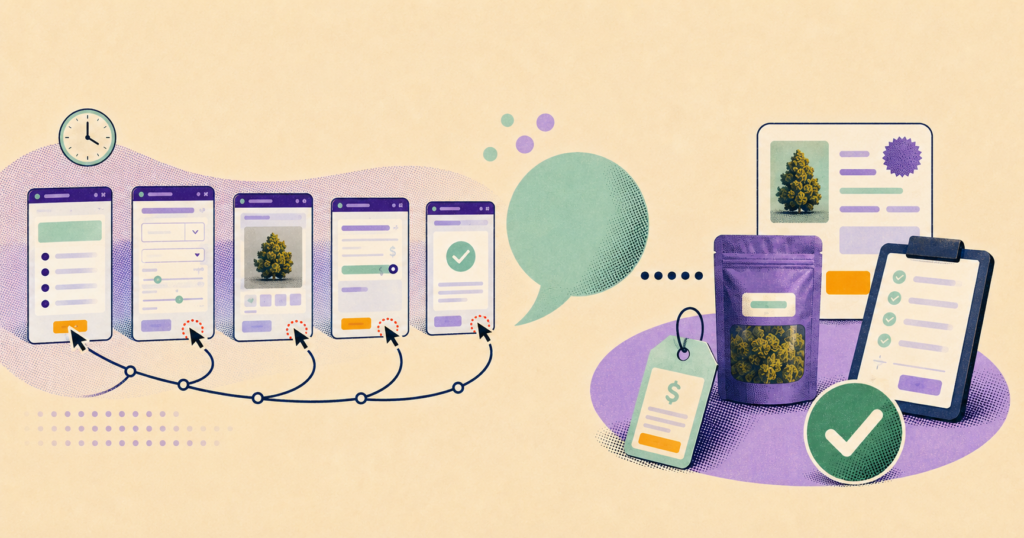
This is one of the most significant shifts in enterprise software since the introduction of the smartphone.
Managers have never actually wanted reports. They’ve wanted decisions and solutions.
The report has always been an intermediate step between a business question and an action. Reports surface the information, but they don’t answer the questions. Should prices change? Which products deserve promotion? Which vendors should receive more shelf space? Which inventory is likely to become a problem next month?
Historically, we gather the data, interpret it, and then manually execute the work.
The challenge I see most operators struggling with is not a lack of data. In fact, dispensaries generate enormous amounts of it. The challenge is making sense of information scattered across sales reports, inventory systems, vendor relationships, marketing calendars, meeting notes, customer behavior, and operational documentation.
AI is exceptionally good at making sense of messy information. It can synthesize disconnected sources, identify patterns that might otherwise be missed, and turn those patterns into useful recommendations.
More importantly, it can help turn those recommendations into action.
Consider a typical planning session for 4/20. The merchandising team discusses inventory strategy. Marketing reviews promotional ideas. Buyers talk through vendor funding opportunities. Operations weighs staffing, inventory capacity, and expected customer demand. By the end of the meeting, everyone has a list of follow-up work that may take days to complete. Disconnected and messy, just like the data dispensaries collect.
Now imagine that 420 meeting was transcribed by AI. Your merchandising calendar lives in one application. Vendor agreements are stored in another. Historical sales, inventory, and customer data live inside your dispensary operating system, such as Flowhub.
Individually, those systems cannot reason together. Connected through AI, they become part of a single workflow.
Instead of assigning half a dozen follow-up tasks, an operator could ask:
“Review our 4/20 planning meeting notes alongside last year’s sales performance, current inventory levels, vendor lead times, customer purchasing trends, and promotional calendar. Recommend an ordering schedule by vendor, identify which brands deserve additional promotional support, build a week-by-week promotion plan leading up to 4/20, and propose a post-4/20 strategy that minimizes excess inventory while protecting margins. Then, draft the promotions, purchase orders, and inventory updates for my approval.”
Rather than manually coordinating work across teams, the operator defines the outcome. AI gathers the relevant context, reasons through the problem, and prepares the work for review.
It connects ideas from the meeting with historical sales, inventory levels, vendor performance, customer behavior, and operational constraints. It starts with recommendations. Then, all through talking in plain language, it prepares promotions, pricing updates, purchase orders, and inventory changes so operators can move from decision to execution in minutes instead of days.
That is what I mean when I say the prompt becomes the new workflow.
Importantly, AI does not replace the operator’s judgment. It changes where that judgment is applied.
Instead of spending hours pulling reports, updating spreadsheets, and making repetitive bulk changes, managers can focus on evaluating recommendations, making strategic decisions, coaching employees, improving the customer experience, and setting the standards for how the business should operate.
The repetitive work becomes automated, and human work becomes more valuable.
This shift in work also changes how retail software should be built.
Here is the reality: nobody knows exactly what AI will look like two years from now.
Innovation is happening overnight. Models are improving rapidly. New tools appear constantly. Capabilities that seemed experimental six months ago are becoming standard. Predictions about which model, interface, or company will dominate are being rewritten almost as quickly as they are made.
That uncertainty is not a reason to wait. It is a reason to stay flexible.
The good news: retailers do not have to be early adopters of every new AI model. They should use technology that gives them room to experiment, adapt, and adopt better tools without replacing the systems they rely on to run their businesses.
The best retail software will give operators the freedom to choose the AI tools that best fit their businesses while remaining flexible enough to adopt future breakthroughs. Technologies such as Model Context Protocols (MCP) make that possible by allowing LLMs such as Claude, ChatGPT, and Gemini to securely connect with business software and take action across multiple applications.
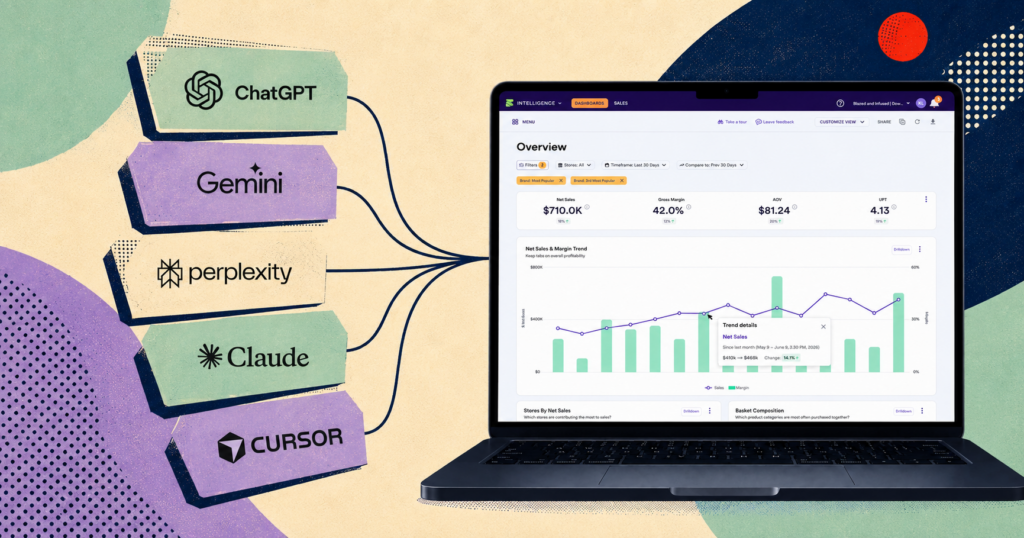
The models themselves are also becoming a commodity, rapidly becoming more affordable. Nearly everyone has access to the same frontier AI systems. Simply having AI will not be a meaningful competitive advantage for long.
The advantage will come from the context you give it: your business data, operating procedures, merchandising strategy, customer relationships, institutional knowledge, and understanding of what matters most.
Context is an ingredient in the recipe of success.
With so much attention around what AI can and cannot do, operators have to lean further into what makes their businesses different. Your unique point of view, taste, judgment, and standards matter more than ever.
AI can synthesize the information you give it. It cannot define the intangibleness of your brand and the experience of your store. It cannot decide what kind of retailer you want to become. It cannot determine what your customers should feel when they walk into your store or which opportunities are worth pursuing.
Those are human decisions.
Without context, AI produces generic answers. Without judgment, it can help produce generic businesses.
That distinction matters because AI is not becoming another feature inside retail software.
It is becoming the interface.
Dashboards will still exist and reports will still have value. Strong business intelligence and reliable first-party data will remain essential sources of truth. But I do not believe dashboards and reports will remain the primary way operators interact with their businesses.
Just as search transformed how people found information and smartphones transformed how people used software, natural language is transforming how work gets done.
You know AI helped me write this article.
I gave it context, it helped organize ideas, challenge assumptions, and improve the structure. I reviewed every section, rewrote large portions, and made the final editorial decisions myself with my human brain!
That is how I believe operators should approach AI.
Do not use it to replace your judgment. Use it to amplify it.