Every time a state moves to end cannabis prohibition, critics dust off the exact same argument. They claim that creating a legal, regulated market will cause a massive spike in cannabis use among youth. For decades, fear tactics have dominated the conversation, overshadowing the actual impact of ending the war on drugs and establishing sensible regulations.
Now, fresh data out of the Midwest is shutting down those tired claims completely. The latest piece of Minnesota cannabis news, supplied by the Minnesota Department of Health highlights a fascinating trend regarding post-legalization behaviors. Following the state’s move to legalize adult-use cannabis in 2023, underage consumption hasn’t skyrocketed. It has actually plummeted to historic lows.
This is a massive win for advocates of sensible drug policy. By bringing the industry out of the shadows, states can implement strict age-gating and safety protocols that the illicit market simply ignores. If you want to understand how legalization truly impacts communities, keeping an eye on the actual rates of cannabis use among youth provides a much clearer picture than the fear-mongering campaigns of the past.
Breaking Down the 2025 Minnesota Student Survey
State health officials recently released the results of their comprehensive 2025 student survey. Conducted every three years, this assessment tracks health and behavioral trends across fifth, eighth, ninth, and eleventh graders. Because Governor Tim Walz signed adult-use legalization into law in 2023, this specific survey represents the first look at behaviors following the end of prohibition.
The numbers tell an incredibly encouraging story. An overwhelming 96 percent of surveyed students reported zero cannabis use over the previous month.
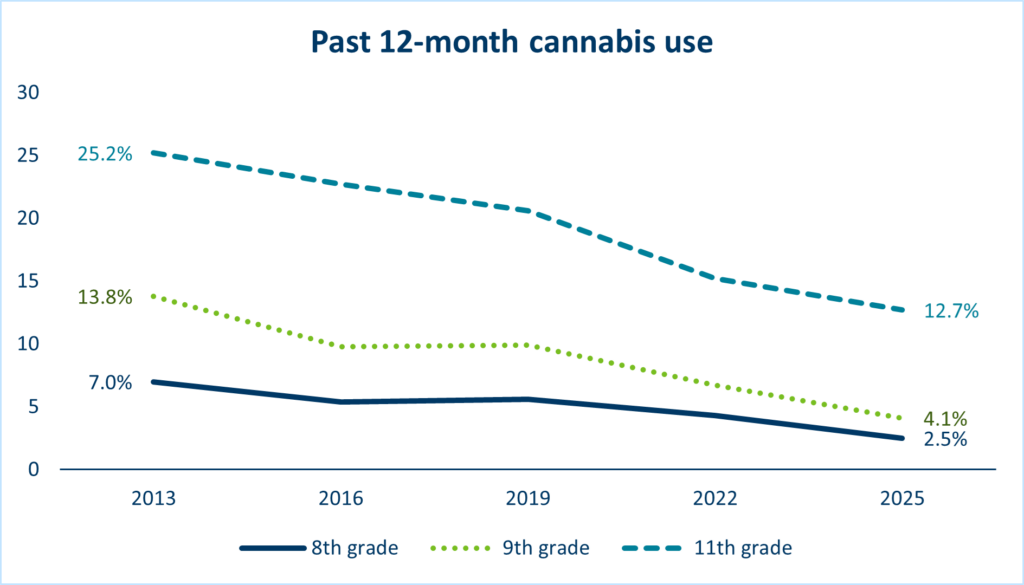
Even more impressively, the state recorded a massive 57.7 percent drop in self-reported past-year consumption among eighth, ninth, and eleventh graders combined between 2013 and 2025. Back in 2013, almost 15 percent of these students admitted to consuming the plant. By 2025, that number shrank to a mere 6.3 percent.
Why Regulated Markets Protect Communities
Opponents of legalization frequently argue that putting dispensaries in neighborhoods will normalize underage consumption. The data actively disproves this theory.
Unlicensed dealers do not ask for identification, nor do they care about the age of their buyers. Licensed dispensaries, operating under strict Minnesota marijuana laws, face severe penalties and the loss of their lucrative licenses if they sell to minors.
Legalization also shifts the conversation from criminalization to education. State health departments can allocate tax revenue to fund honest, science-based educational campaigns. When young people receive factual information rather than outdated propaganda, they make healthier choices.
Interestingly, the survey revealed that students drastically overestimate how many of their peers consume the plant. While 54 percent believed their classmates were regular consumers, the reality showed that 92 percent had never tried it at all.
What the Latest Cannabis News Minnesota Tells Us
Advocates across the country can point to these findings as definitive proof that regulation works. Minnesota joins a growing list of regions, including Canada and several early-adopter U.S. states, that have reported similar declines following adult-use legalization.
Establishing a legal framework fundamentally undercuts the illicit market. It forces unregulated suppliers out of business. This shift creates a safer environment for everyone, ensuring that adults have access to clean, tested products while effectively restricting access for minors. Taking the market away from cartels and placing it in the hands of regulated businesses is the most effective way to keep local communities safe.
The evidence is undeniable. Bringing the cannabis industry into the light protects adult consumers and drives down youth consumption rates simultaneously.
Frequently Asked Questions (FAQ)
Yes, adult-use cannabis became legal in the state on August 1, 2023. Adults 21 and older can legally possess up to two ounces of flower in public and keep up to two pounds at their private residence. Home cultivation is also permitted, allowing adults to grow up to eight plants, with a maximum of four mature, flowering plants at any given time.
Studies repeatedly show that establishing a legal, regulated market either stabilizes or actively reduces underage consumption. By shifting sales from illicit street dealers to licensed dispensaries that strictly enforce ID checks, teens have a much harder time acquiring products.
Key Takeaways
- Recent data from Minnesota shows that cannabis legalization has not increased Cannabis Use Among Youth; instead, it has led to significant declines in underage consumption.
- The 2025 Minnesota Student Survey reported that 96% of students had not used cannabis in the past month, and past-year consumption dropped to 6.3%.
- Legalization enables regulated markets to implement strict age restrictions, unlike unlicensed dealers who do not check IDs.
- Tax revenue from legalization can fund educational campaigns, providing youth with factual information rather than outdated propaganda.
- Minnesota’s success aligns with trends in other regions, demonstrating that regulated markets can lower youth cannabis consumption rates.