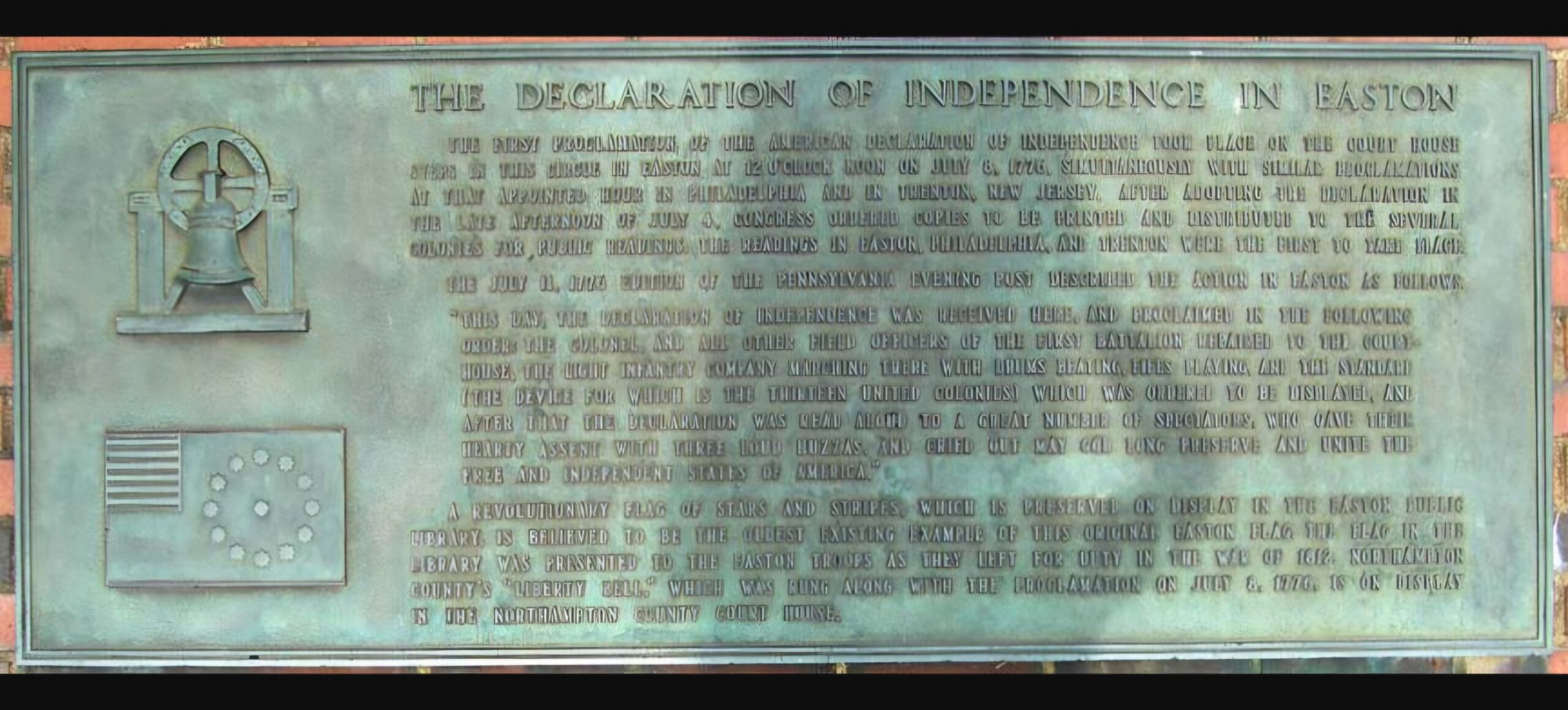
A Strategic Decision in the Birth of American Independence
When the Declaration of Independence was adopted in Philadelphia on July 4, 1776, the act itself was only the beginning. The document needed to be delivered to the people across the colonies, and that process required careful coordination. The Continental Congress did not simply distribute the Declaration at random. Instead, it selected locations that could effectively communicate the message of independence, rally public support, and reinforce the growing structure of revolutionary governance. Among those chosen locations was Easton, Pennsylvania.
On July 8, 1776, the Declaration of Independence was read publicly in Easton, placing it alongside Philadelphia and Trenton as one of the earliest communities to hear the announcement. This decision was rooted in both geography and leadership. Easton was not the largest town in Pennsylvania, but it occupied a position of strategic importance that made it an ideal location for the dissemination of revolutionary information.
Geography That Made Easton Essential
Situated at the meeting point of the Delaware and Lehigh Rivers, Easton functioned as a critical junction between major colonial cities and the western frontier. Trade routes, military pathways, and communication networks all intersected in the town. Information that passed through Easton could travel outward quickly, reaching settlements across Pennsylvania and beyond.
In a time when news moved slowly and depended on physical delivery, Easton’s position allowed it to serve as a powerful distribution point. Choosing Easton ensured that the message of independence would extend beyond urban centers and into the broader population that would ultimately support the Revolution.
Centre Square and the Power of Public Assembly
Easton was also designed with civic life in mind. Centre Square served as a central gathering place where residents assembled to hear announcements and participate in public discussions. The Northampton County courthouse stood at the center of that square, providing a formal and recognizable stage for leadership to address the community.
When the Declaration arrived, there was already a structure in place that allowed it to be delivered in a way that carried both authority and visibility. The environment ensured that the reading would not only be heard but also understood and remembered.
Leadership in Place: The Role of Robert Levers
The effectiveness of Easton as a site for the Declaration reading was also tied to the leadership present at the time. Robert Levers, who delivered the reading, was deeply involved in the revolutionary framework of Northampton County.
As chairman of the Committee of Safety, he played a direct role in organizing resistance, maintaining order, and supporting the transition away from British authority. By the time he stood before the crowd on July 8, 1776, he was already a trusted figure in the community.
The reading of the Declaration in Easton was not an isolated moment. It was the continuation of work already being done by leaders like Levers who had prepared their communities for independence.
As Chairman of the Northampton County Committee of Safety, he wasn’t just a guy handed a piece of paper—he was one of the people responsible for making the Revolution function locally.
When Levers read the Declaration in Easton, he wasn’t introducing a new idea—he was confirming a movement already in motion.
Why Easton Was One of Only Three Cities
The Declaration was not immediately read everywhere. Early readings were limited to select locations that met specific criteria. These communities needed strong leadership, reliable communication networks, and the ability to mobilize public support.
Easton met all of those requirements. Its inclusion alongside Philadelphia and Trenton reflects its importance within the broader Revolutionary strategy. It was not chosen by chance. It was chosen because it was ready.
A Legacy That Still Resonates
The decision to read the Declaration in Easton in 1776 continues to shape the identity of the city today. What began as a strategic move during the Revolution has become a defining part of Easton’s historical legacy.
That legacy is preserved each year through Heritage Day, where the reading is reenacted and the story is passed on to new generations. The moment remains a powerful reminder that independence was not only declared in Philadelphia, but also delivered to communities like Easton that helped bring it to life.
Key Takeaways
- Easton, Pennsylvania played a crucial role in the reading of the Declaration of Independence on July 8, 1776, alongside Philadelphia and Trenton.
- Its strategic location at the junction of the Delaware and Lehigh Rivers made it a vital communication hub for revolutionary information.
- Centre Square served as a public assembly area, allowing the message of independence to be delivered effectively and memorably.
- Leadership by Robert Levers, chairman of the Committee of Safety, ensured the community was prepared for the reading and embraced the revolutionary cause.
- The legacy of the reading endures, as Easton commemorates Heritage Day each year, reinforcing its historical importance in American independence.
Easton was selected because of its strategic location at the intersection of the Delaware and Lehigh Rivers, making it a key communication and transportation hub. This allowed the message of independence to spread efficiently beyond major cities into surrounding regions.
The Declaration of Independence was publicly read in Easton on July 8, 1776—just four days after it was adopted in Philadelphia—making it one of the earliest locations to receive and share the announcement.
Robert Levers, chairman of the Northampton County Committee of Safety, delivered the reading. As a trusted local leader involved in revolutionary efforts, he played a key role in preparing the community for independence.
Easton was chosen alongside Philadelphia and Trenton because it met critical criteria: strong leadership, established communication networks, and the ability to mobilize public support for the (Revolution). It wasn’t random—it was strategic.
Easton commemorates its historical significance through an annual Heritage Day celebration, which includes reenactments of the Declaration’s reading, by Robert Levers in 1776, keeping its Revolutionary legacy alive for future generations.