


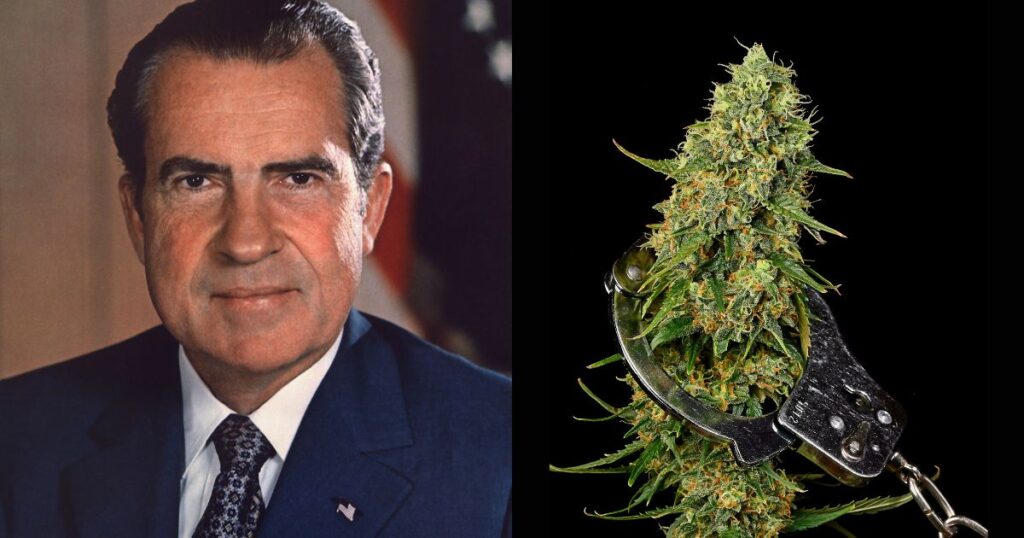
The modern war on cannabis did not begin with science. It began with fear, politics, and control.
In 1970, President Richard Nixon signed the Controlled Substances Act into law, reshaping American drug policy with a sweeping federal framework that still governs cannabis today. The Act created a drug scheduling system meant to classify substances based on medical value and potential for abuse. On the surface, it appeared rational and orderly. In reality, it became the foundation of the War on Drugs, a campaign driven far more by ideology than evidence.
Under the Controlled Substances Act, marijuana was placed into Schedule I, the most restrictive category. Schedule I substances were defined as having a high potential for abuse, no accepted medical use, and no accepted safety under medical supervision. Even at the time, these claims were deeply contested. Today, they are indefensible.
What makes this history impossible to ignore is that Nixon himself understood the science was not settled. Cannabis was placed into Schedule I on a temporary basis while further research was conducted. Nixon promised the public that the classification would be revisited once the evidence was reviewed.
That promise was never honored.
Nixon’s Political Calculus Behind Drug Policy
To know why marijuana was targeted, you have to understand the political climate Nixon was navigating. The late 1960s and early 1970s were defined by civil unrest, antiwar protests, and challenges to entrenched power structures. Cannabis use was common among young people, antiwar activists, and counterculture movements. Nixon viewed those groups as threats.
Later statements from Nixon administration officials confirmed that drug policy was used as a political weapon. Cannabis prohibition gave law enforcement the legal authority to disrupt communities and movements the administration opposed. The Controlled Substances Act provided a federal framework to legitimize that strategy.
Still, Nixon needed cover. Publicly, the administration insisted drug policy was rooted in public health and safety. Privately, they needed a study that would justify prohibition.
That study would end up doing the opposite.
The Creation of the Shafer Commission
To assess marijuana objectively, Nixon authorized the formation of the National Commission on Marihuana and Drug Abuse. The commission was chaired by Raymond P. Shafer, a former Republican governor of Pennsylvania and a trusted establishment figure. This was not a progressive task force or a group of cannabis advocates. It was a conservative, federally appointed body tasked with reviewing the facts.
The Shafer Commission spent nearly two years conducting what was then the most comprehensive federal review of marijuana. Researchers examined medical data, patterns of use, crime statistics, and social impacts. They gathered testimony from scientists, doctors, judges, law enforcement officials, and everyday Americans.
The goal was simple. Determine whether marijuana posed a sufficient danger to justify criminal prohibition.
Marihuana: A Signal of Misunderstanding
In 1972, the commission released its final report, titled Marihuana: A Signal of Misunderstanding. The report challenged nearly every assumption underlying cannabis prohibition.
The commission concluded that marijuana did not pose a serious threat to public health. It found no credible evidence linking cannabis use to violent behavior, also it rejected the theory that marijuana served as a gateway to harder drugs. It also found that the social harms attributed to cannabis were largely the result of criminalization, not use.
Perhaps the most important conclusion was that marijuana prohibition itself caused more damage than marijuana ever had. Arrests and criminal records disrupted lives, limited opportunity, and undermined trust in government institutions. The commission warned that punitive enforcement would have long term consequences, especially for young people.
Based on its findings, the Shafer Commission recommended that marijuana possession for personal use should be decriminalized and that casual use should not be treated as a criminal offense.
By the standards outlined in the Controlled Substances Act, marijuana did not qualify for Schedule I.
Nixon Rejects His Own Commission
Rather than accept the findings, Nixon dismissed them.
White House recordings later revealed Nixon’s hostility toward marijuana users and his refusal to accept conclusions that conflicted with his worldview. Despite commissioning the study, he rejected its recommendations outright. Marijuana remained in Schedule I, not because the science supported it, but because the politics demanded it.
The temporary classification quietly became permanent.
With that decision, the war on cannabis intensified. Federal enforcement expanded. States followed suit. The consequences would span generations.
The Long Term Consequences of Schedule I Status
Keeping marijuana in Schedule I had immediate and lasting effects. Scientific research became nearly impossible due to regulatory barriers. Medical exploration stalled. Patients seeking relief through cannabis were criminalized. Doctors were restricted from studying or recommending it.
At the same time, enforcement of marijuana laws disproportionately targeted Black and Brown communities, despite similar rates of use across racial groups. Low level possession charges resulted in lifelong consequences that extended far beyond any actual harm caused by cannabis itself.
All of this happened while the federal government sat on a report that explicitly stated these outcomes were unnecessary, essentially creating the war on cannabis.
Vindication Through Time
Decades later, nearly every conclusion reached by the Shafer Commission has been validated. Cannabis is now recognized for its medical value. States that regulate cannabis see fewer harms than those that criminalize it. Public education has proven more effective than punishment.
The science did not change. The politics simply caught up.
Yet, despite overwhelming evidence and widespread legalization at the state level, marijuana’s federal classification remains rooted in Nixon era ideology.
Why This History Still Matters
Understanding how cannabis was criminalized matters because it exposes the myth that federal drug policy is science driven. The case of marijuana proves otherwise. The government had the evidence. It chose to ignore it.
Cannabis reform is not about experimenting with new ideas. It is about correcting an old lie that has been allowed to persist for more than fifty years.
At Beard Bros Media, we believe cannabis deserves honest context, not recycled propaganda. The story of Nixon, the Controlled Substances Act, the war on cannabis, and the Shafer Commission shows exactly how bad laws are born. Not from lack of knowledge, but from refusal to listen.
Marijuana never belonged in Schedule I. The federal government knew that in 1972. The damage caused by ignoring that truth is still being repaired today.
If cannabis policy is ever going to align with reality, it starts by acknowledging this history and ending the fiction that prohibition was justified.
The record is clear. The science was clear. The only thing that failed was the law, and the war on cannabis.
- Nixon’s Recordings Claim Marijuana Was “Not Particularly Dangerous” Just Two Years After Launching the War on Drugs
- Big Weed Gets Big Win in the Big Apple
- The Time Is Right To End Workplace Weed Testing
- From Nixon to Biden, Blurring the Line Between Cannabis Clemency and High Level Hypocrisy – Beard Bros Media Continues the Fight to Free Edwin Rubis
- Massachusetts Cannabis Control Commission Faces Major Overhaul as Inspector General Calls for Receiver