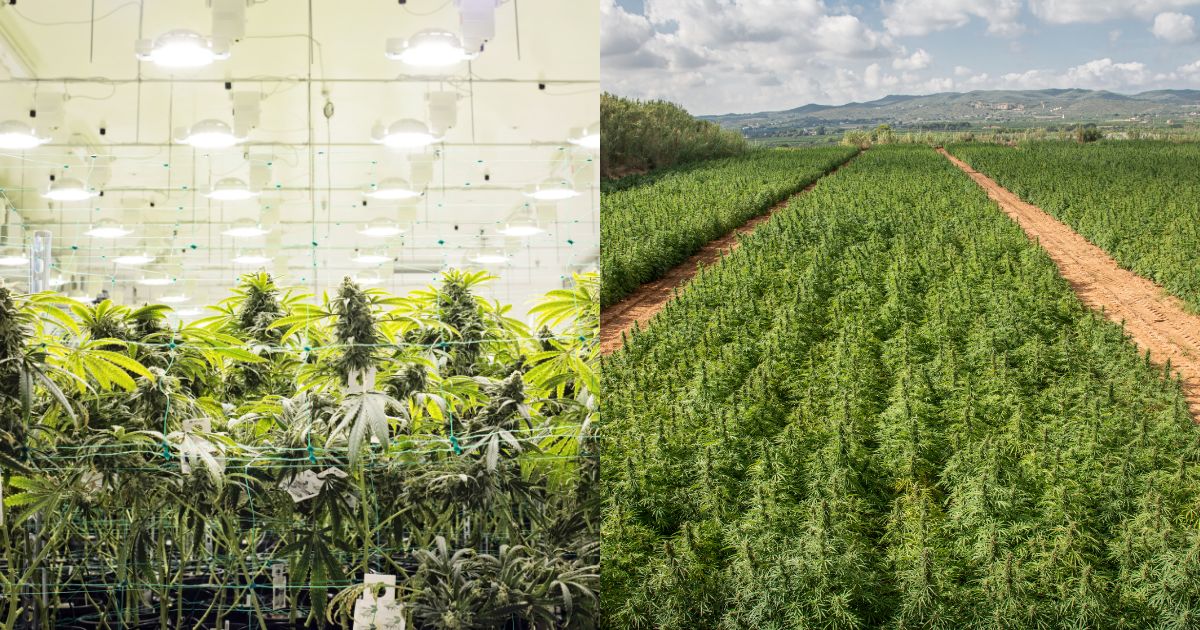
Few debates in cannabis culture are as persistent—or as misunderstood—as the question of indoor vs outdoor cultivation. It’s a conversation that shows up everywhere: dispensary counters, comment sections, cultivation conferences, and backyard sessions. Indoor is often framed as premium. Outdoor is sometimes dismissed as inferior. But the reality is far more nuanced, and far more interesting.
Quality cannabis is not defined by a roof or the lack of one. It is shaped by how a plant experiences its environment over time. Light, stress, genetics, soil, climate, and human decision-making all play a role. Indoor and outdoor cultivation are not opposing forces—they are different tools, each capable of producing exceptional flower when executed with intention.
Understanding what actually shapes quality requires moving past marketing narratives and into how cannabis behaves as a living organism.
The Myth of “Indoor Equals Better”
Indoor cannabis earned its reputation during prohibition, when outdoor cultivation carried enormous risk. Growing indoors meant control—over light, over visibility, over harvest timing. It also meant the ability to grow year-round and dial in consistency when everything else was unpredictable.
Over time, that control became synonymous with quality. Indoor flower was denser, cleaner, and more visually impressive than much of the outdoor cannabis available on the market at the time. But those advantages were contextual, not inherent.
Indoor environments do not automatically produce better cannabis. They simply remove variables. What growers do with that control determines the outcome.
Light: The First Major Divider
The most obvious difference between indoor and outdoor cannabis is light. Outdoor plants grow under the full spectrum of the sun—something no artificial system can truly replicate. Sunlight delivers intensity, spectrum breadth, and natural daily variation that plants have evolved alongside for thousands of years.
Indoor plants, by contrast, grow under carefully engineered light sources. While modern LEDs can mimic many aspects of sunlight, they are still approximations. What they offer instead is consistency. Indoor light does not change unexpectedly. It does not cloud over. It does not shorten days without warning.
This difference shapes plant behavior. Outdoor cannabis often develops broader terpene complexity tied to natural stressors like wind, temperature swings, and UV exposure. Indoor cannabis often expresses tighter structure and more uniform cannabinoid content due to stable conditions.
Neither outcome is inherently superior—it depends on the goal.
Stress: Nature vs Design
Stress is often misunderstood in cannabis cultivation. Too much stress harms quality, but the absence of stress can dull expression. Outdoor plants experience stress as a matter of course—shifts in temperature, changing day length, wind, pests, and soil variability.
These challenges can push plants to express deeply layered terpene profiles as part of their natural defense systems. This is one reason well-grown outdoor cannabis can deliver exceptional aroma and nuanced effects.
Indoor cultivation removes many of these stressors. That can be a strength or a weakness. When indoor environments are too comfortable, plants may lack the signals that trigger secondary metabolite production. Skilled indoor cultivators reintroduce stress intentionally through light intensity, spectrum shifts, temperature changes, and environmental cues.
Quality comes not from avoiding stress, but from managing it.
Terroir and the Outdoor Advantage
Outdoor cannabis is inseparable from its environment. Soil composition, microbial life, elevation, humidity, and seasonal weather patterns all influence how a plant grows and expresses itself. This concept—often referred to as terroir—is well understood in wine and is increasingly recognized in cannabis.
Regions like Humboldt County, Mendocino, and Trinity didn’t earn their reputations by accident. Generations of outdoor cultivation revealed how local conditions shape flavor, effect, and plant structure in ways that cannot be replicated indoors.
Indoor cultivation trades terroir for predictability. The environment is created rather than inherited. That can produce remarkable consistency, but it also removes the regional fingerprint that outdoor cannabis naturally carries.
Indoor Precision and Repeatability
Indoor cultivation excels where repeatability matters. Commercial markets demand uniformity—especially in regulated environments where testing, packaging, and branding rely on predictable results.
Indoor grows allow cultivators to:
- Maintain consistent cannabinoid profiles across harvests
- Schedule production independent of seasons
- Protect crops from weather and environmental risk
This level of control makes indoor cultivation especially well-suited for high-volume production and branded flower programs where consistency is critical.
Light Deprivation: The Hybrid Approach
Light deprivation (“light dep”) cultivation bridges the gap between indoor and outdoor methods. By controlling light exposure in greenhouse environments, growers harness natural sunlight while manipulating flowering cycles.
Light dep offers many of the advantages of outdoor cultivation—full-spectrum sun, lower energy costs, and terroir influence—while introducing a degree of control traditionally associated with indoor grows.
For many cultivators, this approach represents the best of both worlds.
What Consumers Actually Experience
From a consumer perspective, quality is experienced through aroma, flavor, effect, and freshness—not square footage or lighting diagrams. A well-grown outdoor flower can outperform mediocre indoor cannabis every time.
The gap between indoor and outdoor quality has narrowed significantly as cultivation knowledge has improved. Today, the best examples of both methods can stand side by side without embarrassment.
The real difference is not where the plant was grown, but how much care was taken at every step—from genetics to harvest to curing.
The Real Question Growers Should Ask
Instead of asking whether indoor or outdoor is better, cultivators should ask a more useful question: What kind of quality are we trying to produce, and for whom?
Different markets value different attributes. Some prioritize visual perfection and consistency.
Others value flavor depth, sustainability, and regional identity. Indoor and outdoor cultivation serve different needs—and both belong in a mature cannabis ecosystem.
Indoor and outdoor cannabis are not rivals. They are expressions of different philosophies. One emphasizes control and repeatability. The other embraces nature and variability. Quality emerges when cultivators understand the strengths and limitations of each approach and work with the plant instead of against it.
The future of cannabis quality lies not in choosing sides, but in respecting the plant’s ability to express itself under many conditions—when given the right balance of light, stress, and care.