




When Americans think about the Declaration of Independence, they often imagine the moment it was adopted in Philadelphia on July 4, 1776. Yet the story of American independence did not end inside Independence Hall. The message of freedom had to be carried across the colonies and delivered to ordinary citizens town by town. One of the men responsible for bringing that message to the people was Robert Levers, a revolutionary patriot whose leadership in Easton, Pennsylvania placed him at the center of the American independence movement in Northampton County.
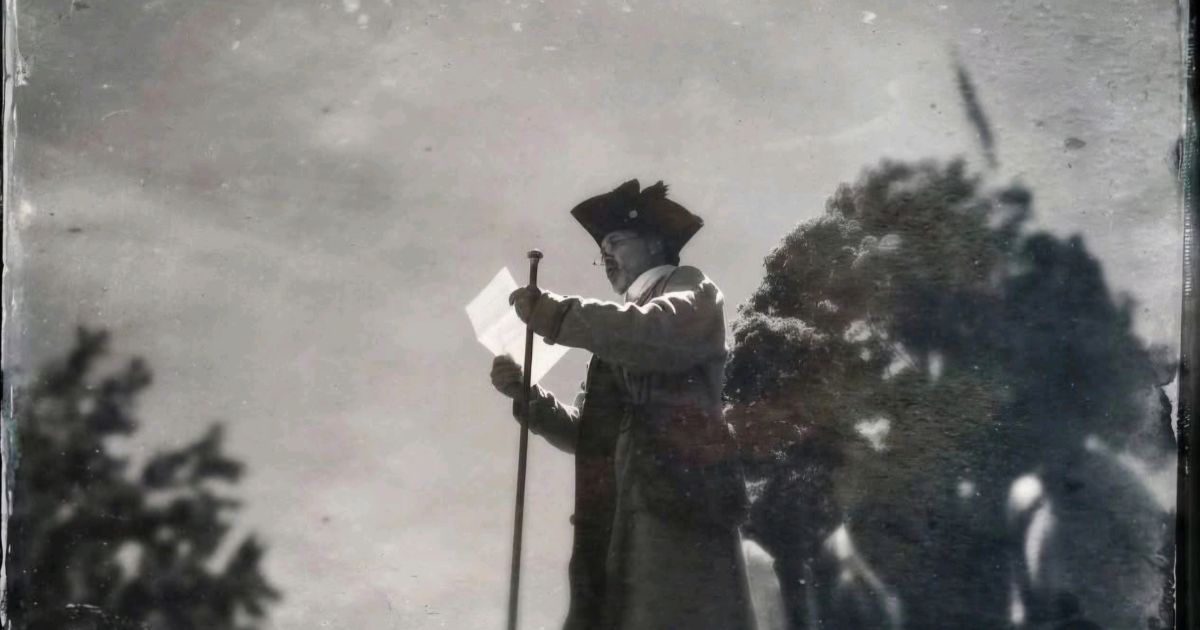
On July 8, 1776, only days after the Continental Congress approved the Declaration of Independence, Robert Levers stood before a crowd gathered in Easton’s town square and publicly read the document that would change the course of history. The moment was more than ceremonial. It represented one of the earliest public proclamations of independence anywhere in the colonies.
For the citizens of Easton and the surrounding region, Robert Levers was the man who first gave voice to the words that declared the birth of a new nation.
Yet the famous reading of the Declaration represents only one part of Robert Levers’ legacy. Throughout the American Revolution, he served Northampton County and Pennsylvania in multiple capacities—as a political organizer, military administrator, financial officer, militia leader, and trusted custodian of revolutionary government records.
His story illustrates how the American Revolution depended not only on famous founders but also on dedicated local patriots who organized communities and sustained the war effort from the ground up.
Early Life of Robert Levers
Robert Levers was born in England and immigrated to the American colonies during the mid-eighteenth century. Historical records indicate that he arrived in Philadelphia in 1748, a time when the city was rapidly growing into one of the most important economic and political centers in colonial America.
Like many immigrants of the era, Levers sought opportunity in the colonies. After spending time in Philadelphia, he eventually settled in Easton, Pennsylvania, a town located at the confluence of the Delaware and Lehigh Rivers.
Easton’s location made it an important hub for trade and transportation between Philadelphia and the western frontier. Wagons carrying goods passed through the town regularly, and its river crossings made it strategically important during times of conflict.
By the early 1770s, tensions between Great Britain and the American colonies were intensifying. Taxes imposed by Parliament, restrictions on colonial trade, and growing resentment toward British authority fueled protests across the colonies.
In Easton, Robert Levers emerged as one of the community’s leading supporters of the Patriot cause.
Easton’s Strategic Role in Revolutionary Pennsylvania
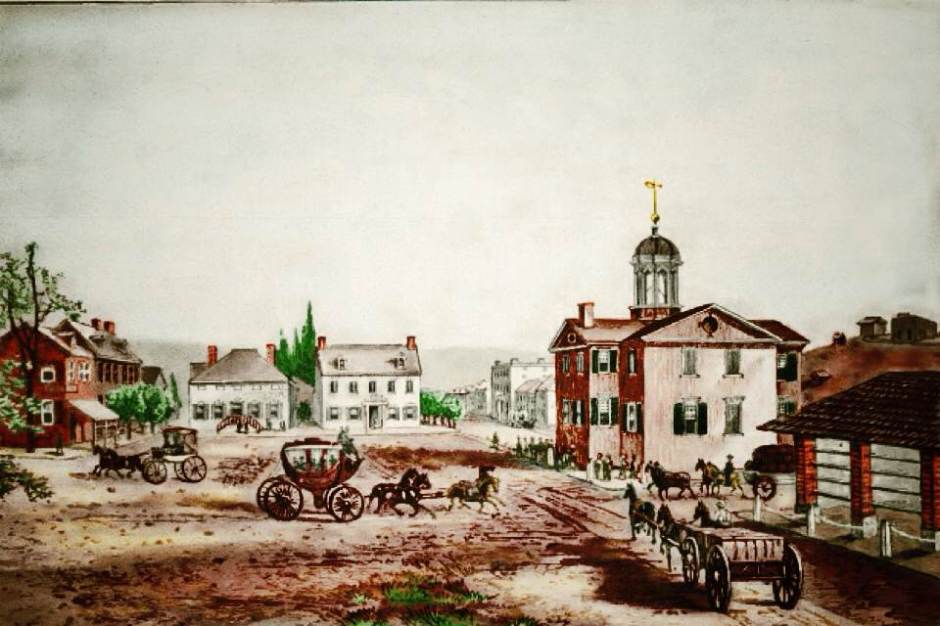
Easton was more than a frontier town. Its location made it a crossroads between the eastern seaboard and the interior of Pennsylvania. The town had been carefully designed in the 1750s by surveyor William Parsons, who laid out the streets around a central public square that became known as Centre Square. This square served as the political and social heart of the community.
In 1765, the Northampton County courthouse was built there, creating a gathering place where citizens assembled to hear news, attend public meetings, and discuss political developments.
When the Revolutionary movement began spreading across the colonies, Easton quickly became a center for organizing resistance against British rule. Its position along important transportation routes allowed troops, supplies, and information to move efficiently through the region. As the war approached, the town became increasingly connected to the Patriot cause.
Robert Levers would soon play a key role in that movement.
The Provincial Conference and the Road to Independence
In June of 1776, representatives from across Pennsylvania gathered in Philadelphia for a historic meeting known as the Provincial Conference of Committees. The purpose of the conference was to determine how the colony should respond to the escalating conflict with Great Britain.
Robert Levers attended the conference as a representative of Northampton County. The delegates met at Carpenter’s Hall and debated whether Pennsylvania should support independence from Britain and how the colony should reorganize its government if independence were declared. At the time, Pennsylvania still operated under a colonial government loyal to the British Crown. If the colonies declared independence, that system would have to be replaced with a new government aligned with the revolutionary cause. The conference ultimately recommended the creation of a new state government that would support independence and coordinate Pennsylvania’s role in the war.
When Robert Levers returned to Easton following the conference, he carried with him the news that the colonies were moving toward a historic break from Britain.
Within weeks, that break would become official.
July 8, 1776: Easton Hears the Declaration From Robert Levers
On July 4, 1776, the Continental Congress adopted the Declaration of Independence.
Printed copies of the document were quickly distributed throughout the colonies so that local leaders could read the Declaration publicly to their communities.
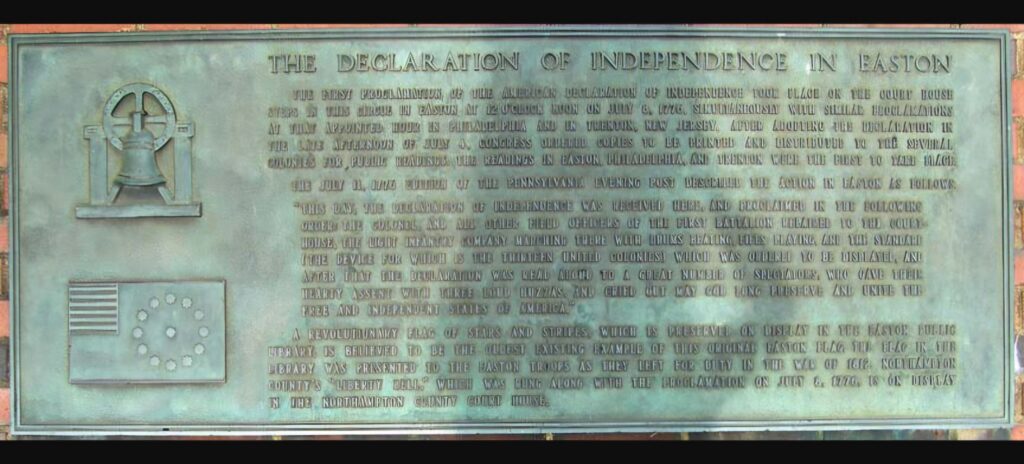
Four days later, on July 8, 1776, citizens gathered in Centre Square in Easton.
Standing before them was Robert Levers, who served as chairman of the Northampton County Committee of Safety. As the crowd assembled near the courthouse steps, Levers began reading the Declaration of Independence aloud. For many of those listening, it was the first time they had heard the official announcement that the American colonies had declared themselves free and independent states.
Easton’s reading of the Declaration was historically significant. On that same day the document was publicly proclaimed in only a few places across the colonies, including Philadelphia and Trenton. Easton therefore became one of the earliest communities to hear the words that declared American independence.
In that moment, Robert Levers became the messenger who delivered the revolutionary announcement to the people of Northampton County.
The Committee of Safety and Revolutionary Government
The reading of the Declaration was not simply a symbolic event. By the summer of 1776, colonial governments loyal to Britain had collapsed in many parts of America.
In their place, communities established Committees of Safety, which functioned as temporary revolutionary governments. These committees were responsible for organizing militia forces, managing supplies, enforcing revolutionary policies, and coordinating resistance against British authority.
In Northampton County, Robert Levers played a central role within this system. His position placed him at the center of the region’s revolutionary administration. Through the Committee of Safety, he helped coordinate military readiness, oversee political decisions, and ensure that Northampton County remained firmly aligned with the Patriot cause.
Paymaster of the 12th Pennsylvania Regiment
Later in 1776, Robert Levers’ responsibilities expanded when he was appointed paymaster of the 12th Pennsylvania Regiment of the Continental Army. The regiment consisted largely of soldiers recruited from Northampton County and surrounding areas.
As paymaster, Levers was responsible for managing the regiment’s finances and distributing soldiers’ wages. This role was vital to maintaining the effectiveness of the Continental Army.
Throughout the Revolutionary War, American forces frequently struggled with shortages of money and supplies. Soldiers sometimes went months without pay, and poor financial administration could lead to desertion or declining morale. Levers’ work helped ensure that the regiment continued to operate despite these difficulties.
Confiscated Loyalist Property
During the Revolution, colonists who remained loyal to Britain were known as Loyalists or Tories. Many fled the colonies or were forced to surrender their property.
Robert Levers served as the agent responsible for confiscated Loyalist property in Northampton County. This position placed him at the center of one of the most challenging aspects of the Revolution. Loyalist property was seized and often sold to help fund the Patriot government and military operations. The work was controversial and could create tension within communities, as confiscations sometimes involved neighbors or former friends.
Despite these challenges, Levers carried out the responsibility as part of the broader effort to support the revolutionary cause.
Lieutenant of Northampton County
By 1781, Robert Levers had become one of the most trusted leaders in the region. That year he was appointed Lieutenant of Northampton County, a position that carried the rank of colonel within the Pennsylvania militia.
In this role, Levers was responsible for organizing and supervising the county’s militia forces. The militia system played an important role during the Revolutionary War. While the Continental Army fought major battles, local militias defended towns, guarded supply routes, and reinforced military campaigns. Levers oversaw recruitment, coordination, and readiness for Northampton County’s militia units, helping ensure that the region remained prepared to support the American cause.
Easton as a Revolutionary Supply Hub
Throughout the war, Easton became an important center for storing and distributing military supplies.
Weapons, ammunition, food, and clothing for Continental soldiers often passed through the town on their way to various fronts of the war. Robert Levers helped oversee the protection and management of these resources. Ensuring that supplies were safely stored and properly distributed was essential to the success of the American military. If captured by British forces, these materials could have severely weakened the Patriot war effort.
Safeguarding Revolutionary Government Records
In 1777, when British forces threatened Philadelphia, the revolutionary government was forced to evacuate the city.
Important documents needed to be moved to secure locations away from the advancing British army. Many of these records were transported to Easton and placed under the protection of Robert Levers. Entrusting him with these documents demonstrated the confidence that revolutionary leaders had in his leadership and reliability. By safeguarding these materials, Levers helped preserve the administrative backbone of the revolutionary government during one of the most vulnerable moments of the war.
Easton During the Revolutionary War
By the time Robert Levers read the Declaration of Independence in 1776, Easton had already experienced decades of frontier conflict that shaped its role during the Revolution. Because of its location between Philadelphia and the frontier territories, the town became a key transportation and logistics hub during the war.
Military supplies passed through Easton on their way to Continental Army forces operating throughout Pennsylvania and the frontier. Roads through the town allowed troops and equipment to move north toward New York and west into frontier settlements. In 1779, Easton served as a staging area for General John Sullivan’s expedition, when thousands of Continental soldiers assembled there before moving north during a major military campaign.
Without towns like Easton functioning as supply and coordination centers, the Continental Army would have struggled to conduct such operations.
Serving as a Patriot leader during the American Revolution was not without risk.
Although many colonists supported independence, Loyalist sympathizers remained throughout the colonies. Officials responsible for enforcing revolutionary policies often faced hostility from those who remained loyal to Britain. Robert Levers’ role in confiscating Loyalist property placed him directly in the middle of these tensions. Carrying out such duties required political resolve and personal courage.
His willingness to accept these responsibilities demonstrates the seriousness with which he supported the revolutionary cause.
The Robert Levers Legacy: From the Revolution to Today
More than two centuries after Robert Levers stood in Easton’s town square and read the Declaration of Independence, his legacy continues through the generations of the Levers family.
Among his descendants is Bill Levers, co-founder of Beard Bros Pharms and Beard Bros Media, organizations known for their work in cannabis advocacy, industry education, and storytelling.
The connection between the two men reflects a broader historical throughline. Robert Levers lived during a time when Americans were debating whether the colonies should remain under British rule or establish a new independent nation. His leadership helped bring the message of independence directly to the citizens of Northampton County.
Generations later, Bill Levers has become involved in another period of social and regulatory change in the United States, working within the evolving cannabis industry and advocating for responsible regulation and transparency.
While the contexts are separated by centuries, both stories reflect individuals participating in important moments of American transformation. The Levers family story therefore bridges two very different eras of American history.
In the eighteenth century, Robert Levers helped deliver the words that declared the birth of the United States. In the twenty-first century, his descendant continues to engage in conversations shaping the country’s evolving policies and culture.
Remembering Robert Levers
Robert Levers’ life represents the kind of commitment and sacrifice that defined the American Revolution at the local level. While the founders in Philadelphia debated independence and generals commanded armies in the field, men like Levers worked tirelessly within their communities to turn revolutionary ideals into practical reality.
He helped organize revolutionary government in Northampton County, managed military finances, oversaw militia operations, safeguarded critical government records, and coordinated supplies that helped sustain the Continental Army. And on that historic day in July of 1776, he stood before the people of Easton and delivered the words that announced the birth of the United States.
Yet the Revolution was not only fought on battlefields. Political divisions ran deep within many communities, and tensions between Patriots and Loyalists often turned personal and violent.
Despite the immense contributions he made to the revolutionary cause, Robert Levers ultimately paid a heavy price for his loyalty to the new nation. Historical accounts indicate that he later suffered injuries inflicted by British sympathizers, wounds that would eventually lead to his death.
It was a tragic end for a man who had devoted years of service to the cause of American independence.
His story reflects the difficult and often dangerous realities of the Revolution, when neighbors sometimes found themselves on opposite sides of a bitter political conflict. The struggle for independence did not end when the Declaration was read aloud—it continued in towns and communities across the colonies, where Patriots like Robert Levers faced real risks for their convictions.
Today, the city of Easton continues to commemorate the historic reading of the Declaration through annual celebrations such as Easton Heritage Day, where reenactments bring visitors back to that moment in July of 1776.
Standing in Centre Square today, it is possible to imagine the crowd gathered more than two centuries ago, listening as Robert Levers spoke the words that would change their lives—and the future of a nation. His life, service, and ultimate sacrifice remain part of the story of how American independence was carried from the halls of Congress into the hearts of the people.
Robert Levers was not simply the man who read the Declaration in Easton.
He was one of the many patriots who helped make its promise possible.