


Let’s start with something that many cannabis brands already know deep down but rarely say out loud: if your marketing strategy depends on one placement working perfectly, it isn’t really a strategy at all. It’s a gamble.
And in the cannabis industry, gambling with visibility can be extremely expensive.
Every year brands across the cannabis ecosystem invest significant resources into single marketing
opportunities. That investment might take the form of a booth at a trade show, a sponsorship at an industry event, a one-off newsletter feature, a digital advertising push, or even an influencer collaboration meant to spark attention quickly. For a moment, those efforts often feel successful.
There is foot traffic, conversations happen, social posts get shared, and brand exposure increases.
Yet when the dust settles, many of those same brands quietly admit something that feels frustratingly familiar: they received exposure, but the effort did not meaningfully move the business forward.
The reason for that disconnect is simple. Exposure and pipeline are not the same thing.
In cannabis marketing, real pipeline is built through repetition, reinforcement, and coordinated distribution across multiple channels. Single moments of visibility rarely create the sustained familiarity required for buyers, retailers, investors, or partners to move toward a decision. Instead, pipeline emerges when brands remain present in the environments where cannabis decision-makers already spend their time and attention.
That reality becomes even more important when events like Hall of Flowers Ventura approach.
Events Create Visibility, But Systems Create Revenue
Events like Hall of Flowers are incredibly valuable for the cannabis industry. They generate energy, facilitate product discovery, and provide opportunities for relationship-building that simply cannot happen through digital channels alone. For many brands, a trade show booth becomes the center of activity for several days, allowing teams to meet retailers, introduce products, and strengthen connections within the cannabis community.
However, the excitement of an event can sometimes create the illusion that momentum will naturally continue once the show ends.
In reality, most events create a spike in attention rather than a sustained wave of engagement. A brand might leave Hall of Flowers with dozens of promising conversations, stacks of business cards, and a full contact list of potential partners. The following week typically includes follow-up emails, social media recaps, and internal conversations about how well the show seemed to go.
Then, almost inevitably, communication begins to fade.
This happens because a single interaction rarely converts into meaningful business, particularly within the cannabis industry. Retail buyers, distributors, investors, and strategic partners rarely make decisions after just one exposure. The cannabis market is regulated, competitive, and heavily relationship-driven. Trust builds slowly, and buyers typically need multiple interactions with a brand before moving forward.
What turns event visibility into actual revenue is not the event itself, but the marketing system that supports what happens afterward.
Why Multi-Channel Cannabis Marketing Changes the Equation
At Beard Bros Media, conversations with cannabis brands frequently return to the same challenge.
Many companies invest heavily in marketing opportunities but struggle to connect those activities into a coherent strategy that builds ongoing visibility.
Multi-channel marketing addresses this problem by coordinating exposure across multiple trusted platforms within the cannabis ecosystem. Instead of relying on one moment of attention, brands reinforce their presence in places where industry decision-makers already engage with content, news, and conversations.
One of the most effective ways to establish that presence is through authority-driven editorial content. When a cannabis brand publishes a thoughtful feature article within an established industry media platform, it creates a piece of content that positions the brand as a knowledgeable participant in the broader cannabis conversation. This type of coverage does more than generate attention; it provides context for the brand’s story and demonstrates credibility within the community.
That credibility becomes especially valuable after events. When a retailer or investor meets a brand at Hall of Flowers and later searches for more information online, the presence of authoritative editorial content can dramatically influence how that brand is perceived. A well-crafted feature article can shorten sales cycles because it reduces uncertainty and provides validation that the company is active and respected within the industry.
Cannabis brands can explore how this approach fits into a broader marketing strategy through
Beard Bros Media’s services here:
https://beardbrospharms.com/media-services
Why Email Distribution Still Drives Action
Another component of a strong multi-channel strategy is email distribution. While email marketing is sometimes dismissed as outdated, the truth is that poorly executed email is what fails—not the channel itself.
Within the cannabis industry, targeted newsletters remain one of the most reliable ways to drive meaningful engagement. A well-positioned feature inside an established newsletter ecosystem can generate direct traffic to a brand’s website, product pages, or announcements. Unlike passive impressions, email clicks represent measurable engagement from readers who are actively exploring more information.
Those clicks matter because they move potential partners deeper into the decision-making process. A single exposure may create awareness, but email reinforcement often creates momentum by encouraging readers to take the next step.
Context Matters in Cannabis Advertising
Advertising within cannabis also benefits greatly from context. Many display advertising campaigns across the internet suffer from poor performance because they appear in environments that have little relevance to cannabis audiences. When ads are scattered across unrelated websites, engagement tends to remain low and brand recall suffers.
Publisher-native placements inside cannabis-focused media environments operate differently.
When a banner or advertisement appears alongside editorial content that readers already trust, the brand message feels relevant to the surrounding conversation. This alignment between content and advertising creates a more natural experience for readers and improves engagement overall.
In this sense, context becomes a powerful performance driver.
Familiarity Builds Trust in Cannabis Markets
Another important factor in cannabis marketing is memory. Buyers and decision-makers rarely act on a single interaction, but repeated exposure creates familiarity, and familiarity builds trust over time.
When someone encounters a brand multiple times across different channels—through an editorial feature, a newsletter mention, a banner placement, and social media amplification—that repetition reinforces the brand’s presence in their mind. Rather than appearing as random marketing noise, those coordinated touchpoints begin to form a recognizable pattern.
Within a relationship-driven industry like cannabis, that pattern of familiarity often becomes the foundation for future business conversations.
Cannabis Marketing Must Also Navigate Compliance Risks
Beyond the benefits of increased visibility, multi-channel marketing also provides an important layer of protection against the regulatory uncertainty that defines cannabis advertising.
Unlike most industries, cannabis brands must navigate constantly shifting platform rules and advertising policies. Social networks frequently restrict cannabis-related content, algorithms can throttle reach without warning, and compliance violations can lead to suspended campaigns or removed accounts.
Relying on a single channel under these conditions creates significant risk. If a platform changes its policies or reduces organic reach, an entire marketing strategy can collapse overnight.
A diversified multi-channel approach distributes that risk while maintaining consistent visibility. Instead of depending on one platform or tactic, brands maintain presence across multiple trusted environments, ensuring that a single disruption does not eliminate their ability to communicate with the market.
The Illusion of the One-Off Marketing Win
Many cannabis companies fall into the trap of single placements because those tactics are easy to explain internally. Purchasing a sponsorship, securing a newsletter feature, or running a single advertising campaign provides a clear and tangible activity that teams can point to as a marketing effort.
However, isolated tactics rarely generate the kind of recurring visibility required to scale revenue over time.
If a company’s goal is to increase monthly revenue per client, retailer, or partner, its marketing strategy must reflect the same long-term thinking. Recurring revenue grows from recurring visibility, and recurring visibility is only possible when marketing efforts are connected within a broader system.
Turning Event Momentum Into a 90-Day Strategy
One practical way to approach this challenge is through a structured ninety-day marketing framework. The first stage focuses on authority by publishing strategic content that clearly positions the brand within the cannabis industry. The second stage reinforces that visibility through newsletter distribution, advertising placements, and social media amplification that extend the reach of the original content. The final stage focuses on optimization by analyzing engagement data, refining messaging, and repeating the cycle to maintain momentum.
When events like Hall of Flowers are integrated into this type of framework, they transform from isolated marketing moments into catalysts for long-term pipeline growth.
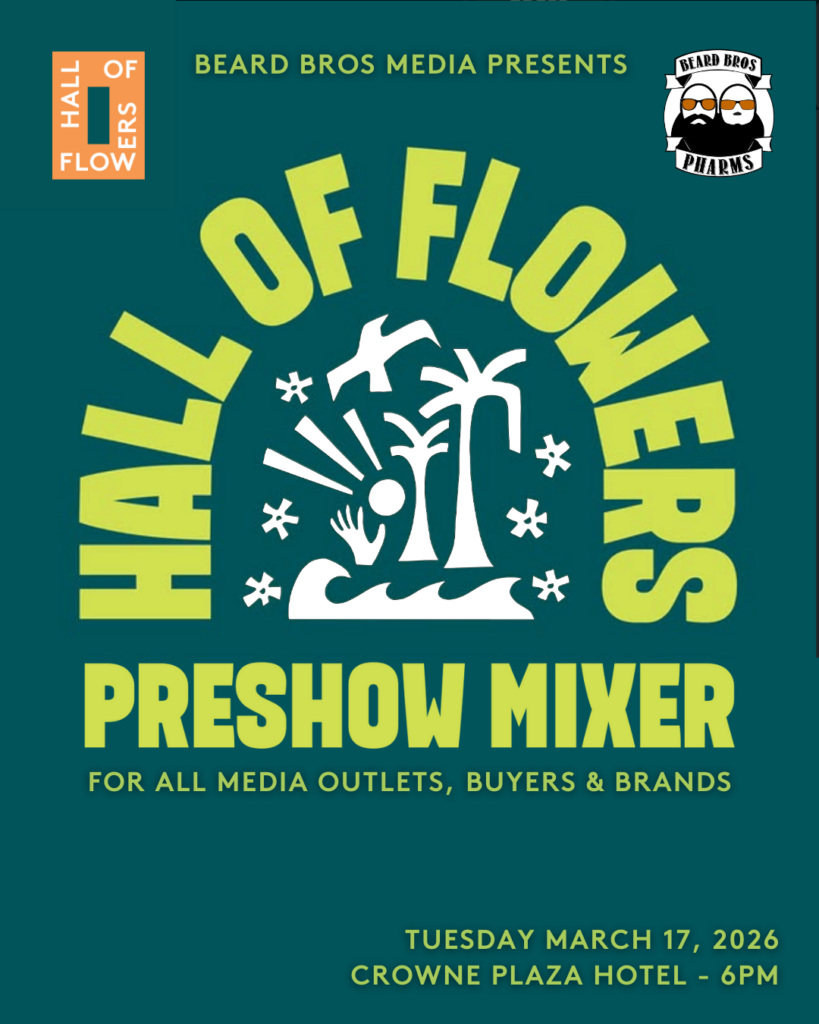
For brands attending the HoF x Beard Bros Media Preshow Mixer on March 17th, the conversation should extend beyond introductions and business cards. The more important question is how to extend the energy of the event into sustained visibility during the months that follow.
What Happens After the Handshake
After every cannabis event, there is a critical moment when potential partners begin researching the brands they encountered on the show floor. Retail buyers revisit conversations they had during the event, investors explore companies that caught their attention, and collaborators evaluate whether a brand fits into their broader network.
At that moment, the question becomes simple: what do they find?
If a brand’s digital presence goes quiet after the event, the opportunity created by those conversations quickly fades. If, on the other hand, those same individuals encounter editorial coverage, social activity, newsletter mentions, and ongoing visibility, the brand remains present in their decision-making process.
Cannabis is fundamentally a relationship industry, but relationships do not grow through a single conversation. They grow through repeated engagement and continued visibility.
For companies investing in events this spring, the goal should not be to maximize a single moment of attention. The real opportunity lies in building a system that extends that moment into months of meaningful engagement.
Ready to Turn Hall of Flowers Into Q2 Momentum?
For brands attending Hall of Flowers Ventura on March 18–19, the most valuable step may be planning the marketing strategy that begins before the show floor even opens. By aligning editorial coverage, newsletter distribution, advertising placements, and social media amplification, companies can transform event visibility into a structured ninety-day pipeline strategy.
Those interested in building that type of coordinated approach can schedule a strategy conversation with the Beard Bros team here:
https://beardbrospharms.com/contact
Because in cannabis marketing, a single placement creates a moment of attention.
A multi-channel strategy creates momentum.
- Stop Buying “Placements.” Start Buying Reliability.
- Confidence Is a Contact Sport
- 5 Compelling Reasons to Adopt Programmatic Advertising in Cannabis Marketing
- Multi-Channel Isn’t “Extra” — It’s How Cannabis Marketing Survives the Algorithm
- Missouri Hemp Farmers Form Missourians for a Single Market in Attempt to Redefine Regulations