

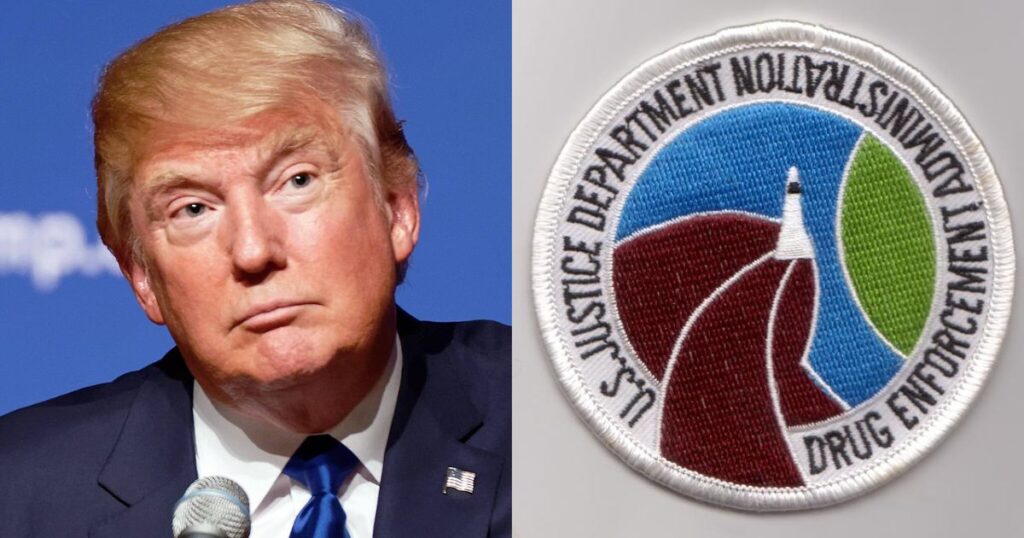
With President Donald Trump now now nearly a year into his second term, conversations around federal cannabis reform have moved from campaign rhetoric to real-time speculation. Industry headlines, social media posts, and political commentary are already buzzing with claims that marijuana rescheduling could happen quickly under his administration.
But before expectations run ahead of reality, it’s important to clarify one critical point: even as president, Trump does not have the legal authority to reschedule cannabis on his own.
What he can do — and what is currently being discussed — is initiate the federal process that may eventually lead to rescheduling. That distinction matters, because starting the process and completing it are two very different things under U.S. law.
To understand what happens next, we need to take a look at the federal cannabis scheduling process, who controls it, and why even a motivated president cannot flip the switch overnight.
Cannabis Scheduling Is Not a Presidential Power
Cannabis is classified under the Controlled Substances Act (CSA), a federal law enacted by Congress in 1970. The CSA does not grant presidents unilateral authority to move substances between schedules. Instead, it places that responsibility within a regulatory framework controlled by federal agencies — most notably the Department of Health and Human Services (HHS) and the Drug Enforcement Administration (DEA).
This structure was intentional. Congress designed the system so that drug scheduling decisions would be grounded in medical and scientific review rather than executive preference. As a result, the president’s role is influential, but not decisive.
If a president could reschedule cannabis outright with an executive order, the Controlled Substances Act would effectively be irrelevant. That is not how the law is written, and it is not how it operates.
What Schedule I Means — And Why Cannabis Is Still There
Under the Controlled Substances Act, cannabis still currently remains classified as a Schedule I substance, the most restrictive category under federal law. The law defines Schedule I substances as drugs with no accepted medical use, a high potential for abuse, and a lack of accepted safety for use under medical supervision.
This classification places cannabis in the same legal category as heroin.
That position is increasingly disconnected from reality. Most U.S. states recognize medical cannabis. Millions of patients use it legally under physician guidance. FDA-approved cannabinoid medications exist. Entire regulated cannabis industries operate openly across large portions of the country.
And yet, federal law still defines cannabis as having no medical value. This contradiction is precisely why officials are discussing rescheduling now—but that doesn’t change who controls the process.
What the President Can Do: Initiate the Review
While President Trump cannot directly reschedule cannabis, he can direct federal agencies to speed up their formal review of cannabis’ status under the Controlled Substances Act, which was started in 2022 by then President Biden.
Specifically, the president may instruct the Attorney General, the Department of Justice, or the Department of Health and Human Services to conduct a medical and scientific evaluation of cannabis. That instruction triggers the rescheduling process established by law.
This is not hypothetical. A similar directive issued under the previous administration launched the current review that led HHS to recommend moving cannabis to Schedule III. However, that recommendation alone did not change federal law — and neither would a new directive without the steps that follow.
Trump can accelerate attention. He can elevate priority. But he cannot skip the process.
Why the Process Takes So Long
Once a review is initiated, the pace slows considerably.
HHS is required to conduct a comprehensive medical and scientific evaluation of cannabis. This includes reviewing existing research, pharmacological effects, abuse potential, patterns of use, and public health impacts. Central to this evaluation is the Eight-Factor Analysis, a statutory framework mandated by the Controlled Substances Act.
That analysis examines issues such as medical utility, dependence liability, and risk to public health. It is detailed, technical, and legally required. For a substance as politically charged and historically stigmatized as cannabis, this stage alone can take months or years.
After completing its review, HHS issues a scheduling recommendation to the DEA. While that recommendation carries significant weight, it is not binding.
The DEA Still Holds the Final Authority
Under current law, the DEA retains final authority over federal drug scheduling decisions.
Once the DEA receives HHS’s recommendation, it conducts its own internal review and determines whether to initiate formal rulemaking. If it proceeds, the agency must publish a proposed rule, open a public comment period, review submissions, and complete the administrative rulemaking process.
Historically, the DEA has resisted cannabis reform and has denied multiple rescheduling petitions over the past several decades. That institutional history explains why rescheduling efforts tend to move slowly, even when political momentum exists.
A Real-World Timeline: How Long This Usually Takes
The most recent federal cannabis review illustrates how long the process typically unfolds.
The review began in late 2022. HHS delivered its recommendation in 2023. As of 2025, the DEA’s review and rulemaking process is still ongoing.
That timeline is not an anomaly. Drug rescheduling efforts often take two to five years, and cannabis has consistently been on the longer end of that range. This is why you should approach claims of rapid rescheduling — no matter who is in the White House — with caution.
What Trump Can Influence — But Not Control
Although Trump cannot reschedule cannabis unilaterally, the presidency still carries meaningful influence.
A president can appoint agency leadership that is more receptive to reform. They can apply pressure to move reviews forward. They can shift enforcement priorities and publicly support legislative reform. They can also encourage Congress to pursue statutory changes that bypass the DEA entirely.
What they cannot do is override federal administrative law or compress years of regulatory process into weeks.
Rescheduling Is Not Legalization
It is also essential to distinguish between rescheduling and descheduling.
Rescheduling would move cannabis to a lower schedule under the Controlled Substances Act, potentially easing restrictions related to taxation and research. It would not legalize cannabis federally, eliminate DEA oversight, or fully protect cannabis businesses from federal risk.
Descheduling — removing cannabis from the Controlled Substances Act altogether — would require an act of Congress. No president has the authority to do that alone.
Why This Distinction Matters Right Now
With rescheduling discussions happening in real time, misunderstanding presidential authority can lead to unrealistic expectations across the cannabis industry. Markets react to speculation.
Businesses plan around perceived momentum. When timelines stretch, the consequences are real.
Understanding the difference between initiating a process and completing it is not cynical — it’s practical.
President Trump cannot reschedule cannabis by himself. That limitation is written into federal law.
What he can do is initiate the review process or speed up the process, influence agency priorities, and support legislative reform. Those actions matter — but they do not override the Controlled Substances Act or the administrative process it mandates.
Cannabis reform in the United States is constrained by decades of law, bureaucracy, and institutional resistance, rather than by a single president. Real change comes through sustained pressure, regulatory action, and legislation — usually in that order.
- Maryland Takes Away The Smell Test From Police
- Where Do They Stand? Donald Trump
- Federal Marijuana Rescheduling Is ‘Finally On The Horizon’ Under the Trump Administration, says Matt Gaetz
- Self-Certification Law Causes Spike in D.C. Medical Marijuana Patients
- Should We Trust Trump to Protect Cannabis?