The DEA marijuana (cannabis) scheduling hearing began Monday with a lot of confusion about what this hearing is about, its potential impact, and most importantly, what it will mean for patients.
The fact that this hearing is happening after AG Order No. 6754-2026 created a federal medical cannabis pathway for certain qualifying state-licensed medical cannabis activity has added to that confusion.
Many patients and advocates have looked at the witness list and asked why so many anti-cannabis voices are participating. Some businesses are treating the hearing as if it could legalize adult-use cannabis or replace the need for DEA registration. Some regulators appear to be waiting for the hearing instead of helping eligible medical cannabis businesses prepare for the new federal pathway.
ASA has warned that these misguided notions about the ALJ hearing are putting cannabis businesses and patients at risk.
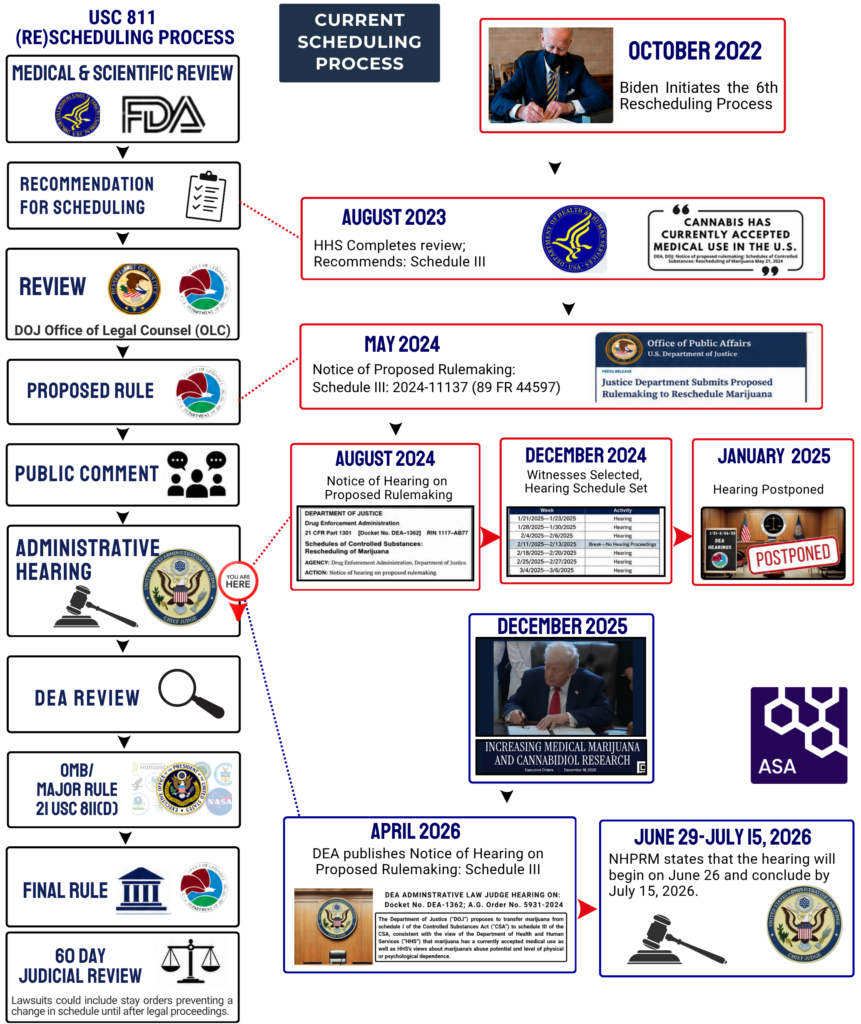
The hearing is the last phase before the DEA finishes the scheduling process President Biden initiated in 2022.
The current marijuana scheduling process began in October 2022, when President Biden directed federal agencies to review marijuana’s status under the Controlled Substances Act. In August 2023, HHS completed its scientific and medical review and recommended moving marijuana to Schedule III. In May 2024, the DOJ published a proposed rule to transfer marijuana from Schedule I to Schedule III.
That process stalled after procedural fights and delays in the earlier DEA administrative hearing. DEA has now withdrawn the prior notice of hearing, terminated those proceedings, and started a new hearing process intended to move more quickly.
For patients, the central point is simple: this hearing is not starting from zero. Federal health officials have already recognized that marijuana has a currently accepted medical use in treatment in the United States. That is a major shift after decades of patients being treated as if their medicine had no medical value.
DEA’s role is to defend moving marijuana to Schedule III.
The government is the proponent of the proposed rule. That means DEA will be defending the proposed transfer of marijuana from Schedule I to Schedule III. Considering DEA’s history of doing everything possible to prevent cannabis rescheduling, advocates have reason to be wary.
However, reporting on DEA’s filings shows that DEA’s witnesses are expected to support the federal scientific and regulatory basis for Schedule III. That includes testimony about HHS and FDA’s eight-factor analysis, the finding that cannabis has a currently accepted medical use, and the federal assessment of marijuana’s abuse potential and dependence profile.
DEA has chosen Dr. Corey Burchman, a New Hampshire physician with more than 30 years of medical practice experience. He is expected to testify as a medical expert in pain management and to discuss clinical experience with the use of medical cannabis.
Dominic Chiapperino, Director of the Controlled Substance Staff at FDA’s Center for Drug Evaluation and Research, is expected to testify about the federal eight-factor analysis used to assess cannabis’ currently accepted medical use in treatment in the United States.
Patients should not mistake the presence of opposition witnesses for the government changing sides. DEA is not convening a public opinion forum. DEA is defending the proposed scheduling action.
“Interested parties” are parties claiming they will be harmed by Schedule III.
Many patients are understandably frustrated by the witness list. It includes organizations and individuals focused on workplace drug testing, drugged driving, law enforcement, anti-marijuana advocacy, and states opposed to the proposed rule. That can make the hearing look stacked against patients.
But under the Controlled Substances Act, administrative hearings are not designed to include every stakeholder or create a balanced cross-section of the cannabis debate. The process is built around parties who claim they are adversely affected or legally aggrieved by the proposed scheduling action.
In plain English, the hearing is structured largely for parties objecting to Schedule III, not every organization that supports moving marijuana out of Schedule I.
That is why the witness list includes groups such as the National Drug & Alcohol Screening Association, the Tennessee Bureau of Investigation, Smart Approaches to Marijuana, states challenging the rule, drugged-driving victim advocates, and medical or pharmacy professionals raising safety, labeling, impairment, or procedural concerns.
This hearing is narrower than many people think.
This may be the most important point.
ALJ says the hearing will not revisit the rescheduling of FDA-approved marijuana products or medical marijuana products already regulated by qualifying state medical cannabis systems because he says that has already been addressed under AG Order No. 6754-2026.
The hearing is focused on whether the remainder of marijuana, as defined under the CSA, should be transferred from Schedule I to Schedule III.
That distinction matters because some cannabis businesses are treating the ALJ hearing as if it might legalize adult-use cannabis or give all cannabis businesses the same benefits they would receive from DEA registration. That is dangerous and wrong.
Schedule III is still a controlled substance. Moving marijuana to Schedule III would not automatically legalize cannabis businesses. Businesses that manufacture, distribute, dispense, or handle Schedule III substances generally must operate within federal registration and regulatory requirements.
The proposed rule itself makes clear that, if marijuana is moved to Schedule III, the manufacture, distribution, dispensing, and possession of marijuana would remain subject to applicable federal controlled-substance laws. That means rescheduling is not the same as legalization. It is not a free pass. It is not federal adult-use legalization in a lab coat.
For patients, the risk is that businesses and regulators will wait for this hearing rather than act now to preserve access to medical care. Patients cannot exercise new federal medical cannabis protections and privileges without access to medical cannabis. A federal medical framework only works if patients have current documentation and if products are cultivated, processed, tested, distributed, and dispensed through a documented medical supply chain.
That is why ASA is calling on states to act now to bring patients federal protections and to prepare for federal cannabis regulation and enforcement.
Patients need transparency because this hearing affects their medicine, rights, and access.
DEA has said the hearing will be open to the public and media in a limited capacity and that a finalized and “corrected transcript” will be posted after the proceedings. ALJ hearings are not court cases. The judge decides what will be put into the record about the proceedings.
Patients with disabilities, serious illnesses, limited income, caregiving responsibilities, immune-system concerns, or travel barriers should not have to get to Arlington, Virginia, and hope there is a seat in a limited-capacity hearing room to observe a federal proceeding about their medicine.
ASA and other patient advocates asked the DEA Administrative Law Judge to reconsider the ban on livestreaming the marijuana rescheduling hearing. The judge did not reply to our request.
Possible Outcomes of the Hearing and What Comes Next
The DEA hearing is expected to conclude on July 15, 2026, but there is no specific deadline for Chief Administrative Law Judge Derek C. Julius to issue his recommendation. It is also important for patients to understand that DEA is not legally bound by the ALJ’s recommendation.
Patients have seen this before. The last major DEA administrative hearing on cannabis scheduling concluded in 1985, when Administrative Law Judge Francis Young found that it would be arbitrary and capricious for DEA to continue standing between patients and access to medical cannabis. DEA rejected that recommendation and continued to keep cannabis in Schedule I.
That history matters, but Monday’s record is very different. The federal government has now determined that cannabis has a currently accepted medical use in treatment in the United States. That makes continued Schedule I treatment far harder to defend because Schedule I is reserved for substances with no currently accepted medical use.
After the ALJ issues a recommendation, the DEA Administrator will review the hearing record, the ALJ’s findings, public comments, and the federal scientific and medical analysis. DEA will then decide whether to issue a final rule. DEA could finalize Schedule III, modify the proposed scheduling decision, or attempt to leave marijuana in Schedule I. Keeping marijuana in Schedule I would invite serious legal and scientific challenges because it would conflict with the federal accepted-medical-use finding.
Once DEA issues a final rule, the rule can take legal effect, but it will also be followed by a 60-day judicial review period. During that time, parties may file lawsuits challenging the decision or the process used to reach it. A lawsuit does not automatically stop the rule from taking effect, but a court could issue a stay or other order delaying implementation while the legal challenge proceeds.
Schedule III will not provide immediate access to every patient in every state. It will not legalize adult-use cannabis. It will not eliminate the need for state action, federal guidance, DEA registration, medical supply-chain documentation, or congressional reform. But Schedule III would create a powerful foundation for Congress to go beyond AG Order No. 6754-2026 and establish a national medical cannabis access program.
Now that the federal government has recognized cannabis as having currently accepted medical use, patients should not have to rely on expensive, exhausting court battles to secure access to medicine. Congress should act to create a clear, durable federal access pathway that protects patients no matter where they live.
No matter what happens at the hearing, patients will still need to fight on two fronts: at the state level for immediate protections, enrollment, supply-chain access, and civil rights enforcement; and at the federal level for long-term congressional action that turns federal recognition into real access.
Patients Should Understand and Assert Their Rights
Federal recognition only matters if patients know how to use it. Medical cannabis patients should not wait for agencies, employers, landlords, healthcare systems, or state officials to explain these changes for them. Patients need to understand what documentation they have, keep their state medical cannabis registration current where available, and be prepared to assert their rights when cannabis status is used against them.
ASA has created a patient resource to help medical cannabis patients understand the new federal protections and privileges connected to medical cannabis status. Patients can use ASA’s guide, Claim Your Federal Protections & Privileges, to learn what has changed, why staying registered matters, and how to begin asking for individualized review in areas such as housing, healthcare, disability accommodations, employment, education, and other settings where patients have too often faced automatic denial or discrimination.
Don’t Wait, Act Now!
Patients, caregivers, and advocates should not wait until the hearing ends before taking action. Know your status and claim your federal protections. Ask your state what it is doing to protect access to medical cannabis. Tell Congress to create a national medical cannabis access program. And keep pressure on President Trump and federal agencies to protect patient rights. Medical cannabis patients have spent decades fighting for federal recognition. Now they need to use that recognition to secure real access, real protections, and real accountability.
Patients can learn more about ASA’s work to protect medical cannabis access, patient rights, and federal implementation at Americans for Safe Access.

Steph Sherer is a pioneering international leader and expert in medical cannabis patient advocacy. Her personal experience with the therapeutic benefits of cannabis, combined with her background in political organizing, led her to establish Americans for Safe Access (ASA) in 2002. Under her guidance, ASA has grown into the nation’s largest patient-centered organization dedicated to ensuring access to medical cannabis, bridging gaps in knowledge, policy, and regulation, and promoting its recognition as a legitimate medical therapy.
For more than two decades, Sherer has spearheaded successful advocacy campaigns at the local, state, federal, and international levels. She has trained over 100,000 individuals in civic engagement, built a powerful grassroots movement for medical cannabis, and worked with lawmakers across the country to shape and improve medical cannabis legislation. As a skilled spokesperson and strategic campaigner, Sherer has consistently elevated patient voices, influencing policymakers on Capitol Hill and driving progress toward a comprehensive national medical cannabis program and the federal recognition of botanical cannabis medicines.
Sherer’s career is defined by her commitment to eradicating inequities in health and well-being. Under her leadership, ASA achieved significant milestones, including establishing state medical cannabis programs, safeguarding state laws through impact litigation, ending federal interference with these programs, and securing protections for medical professionals. ASA, under Sherer’s direction, also championed the creation of the first product safety standards for the cannabis and hemp supply chain in partnership with the American Herbal Products Association and the American Herbal Pharmacopeia, removed federal barriers to research, collaborated with the World Health Organization to acknowledge the plant’s therapeutic benefits, helped change the international scheduling of cannabis in drug treaties, and provided guidance and data to the FDA toward recognizing “currently accepted medical use” for cannabis.
After several years spent advancing national medical cannabis frameworks abroad, guiding cutting-edge research initiatives, and reforming international drug policies, Sherer returned to her role as Executive Director of ASA in 2024. She now leads a nationwide initiative—ASA’s “second act”—to fully integrate cannabis-based medicines into the U.S. healthcare system, ensuring that patient needs, rights, and outcomes remain central to this transformative era in medicine.