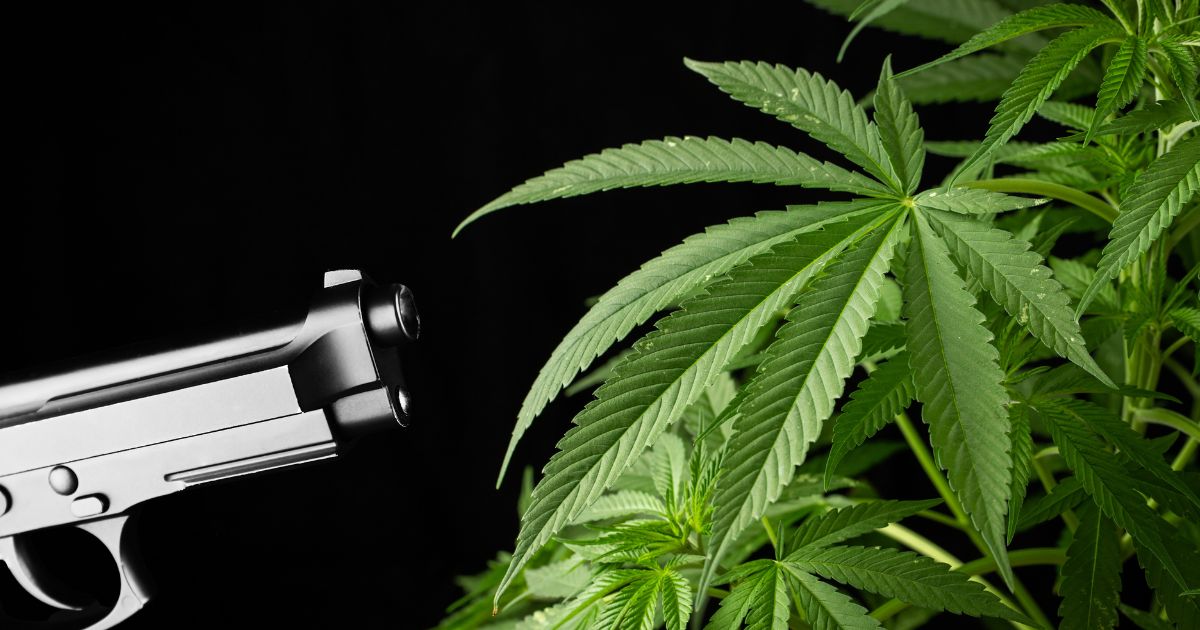
For decades, millions of Americans have been forced to make an impossible choice between two constitutional rights. You can either exercise your Second Amendment right to bear arms, or you can exercise your right to consume cannabis in states where it is legal for medical or adult use. You cannot do both. Under current federal law, specifically 18 U.S.C. § 922(g)(3), anyone who is an “unlawful user” of a controlled substance is effectively stripped of their right to own a firearm.
Long-standing cannabis prohibition has criminalized responsible gun owners simply for choosing a plant over a pill or a cocktail. However, the legal landscape surrounding cannabis is shifting rapidly. In a move that has surprised some political observers but makes perfect sense to constitutional scholars, the National Rifle Association (NRA) has officially stepped into the ring, and has backed the rights of cannabis users right to own guns.
By filing an amicus brief in the upcoming Supreme Court case United States v. Hemani, the NRA is arguing that banning cannabis consumers from owning guns is a violation of the Constitution.
The Case That Could Change Everything
To understand why this is significant, we have to look at the case at the center of the storm: United States v. Hemani. Ali Danial Hemani was indicted for possessing a pistol while being an “unlawful user” of marijuana.
Under the federal statute 922(g)(3), the government does not need to prove that a person was high at the moment they touched a gun, nor do they need to prove the person was violent. They simply need to prove that the person used cannabis and possessed a firearm.
However, the legal tides turned when the United States Court of Appeals for the Fifth Circuit ruled in favor of Hemani. The court affirmed that disarming a person based solely on their status as a marijuana user violates the Second Amendment.
The court relied on the precedent set by New York State Rifle & Pistol Association v. Bruen, which requires gun laws to be consistent with the nation’s historical tradition of firearm regulation. The federal government, unwilling to accept this limitation on its power, appealed to the Supreme Court. The highest court in the land has agreed to hear the case, with oral arguments scheduled for March 2, 2026.
The NRA’s Constitutional Argument in Support of Cannabis Users Gun Rights
The National Rifle Association’s involvement in this case could signifies a major shift in the conversation regarding gun rights and drug policy. In their amicus brief, the NRA—along with the Independence Institute and FPC Action Foundation—dismantles the government’s justification for the ban. Their argument rests on a crucial distinction between “conduct” and “status.”
The NRA argues that throughout American history, there were indeed laws regarding intoxicants and weapons. However, those historical laws were conduct-based. They prohibited specific actions, such as carrying or firing a gun while actively intoxicated.
They did not disarm people entirely just because they were known to drink alcohol or use other substances during their off-hours. The brief emphasizes that the government cannot point to a historical tradition of disarming sober citizens simply because they sometimes use an intoxicant.
Furthermore, the brief attacks the government’s attempt to label all cannabis users as inherently “dangerous.” The NRA asserts that individual disarmament under the Constitution must be based on a demonstrated danger to the community.
The government, they argue, has made no serious effort to establish a factual connection between marijuana use and dangerousness. Instead, the statute relies on an outdated presumption that anyone who uses cannabis is too irresponsible to exercise a fundamental constitutional right.
By challenging this presumption, the NRA is effectively arguing that a responsible cannabis user is no different from a responsible alcohol consumer in the eyes of the Second Amendment.
The Significance of NRA Support for Cannabis Users’ Gun Rights
The National Rifle Association (NRA) is supporting cannabis users’ right to bear arms, a noteworthy stance given the organization’s unparalleled size and influence in the United States. With millions of members, the NRA is the largest gun rights advocacy group in the country, wielding considerable political and cultural influence.
Their extensive funding and strategic lobbying have made them a dominant force in shaping Second Amendment policies for decades.
The NRA’s decision to take a stand on behalf of cannabis users not only underscores the broader implications of this issue but also reflects a shift in its stance toward a traditionally controversial demographic.
By advocating for the inclusion of responsible cannabis consumers in the exercise of gun ownership rights, the NRA signals the expanding boundaries of its advocacy and highlights the evolving discourse on cannabis legalization and constitutional rights.
NORML Enters the Fray
While the NRA attacks the ban from a gun rights perspective, the National Organization for the Reform of Marijuana Laws (NORML) attacks it from a civil liberties perspective. NORML also filed an amicus brief in United States v. Hemani, providing a complementary argument that reinforces the idea that cannabis users should not be treated as second-class citizens.
NORML argues that the Second Amendment clearly protects cannabis consumers as part of “the people.” These individuals are not enemy combatants or felons; they are ordinary citizens, veterans, parents, and patients who are abiding by the laws of their respective states.
NORML points out the glaring hypocrisy of a federal government that simultaneously protects state medical cannabis programs through spending bills while arguing in court that the patients in those programs are too dangerous to own a handgun for self-defense.
The NORML brief also highlights the historical mismatch at the heart of the government’s case. Hemp and cannabis were ubiquitous crops during the Founding Era. Many of the Founding Fathers grew hemp. No historical evidence from the 18th or 19th centuries suggests that using cannabis was grounds for losing one’s right to bear arms.
NORML challenges the government’s claim of a tradition of disarming cannabis users by highlighting how socially normalized cannabis use was throughout much of American history.
The Problem with “Status-Based” Bans
One of the most compelling points raised by both the NRA and cannabis advocates is the danger of status-based bans. Section 922(g)(3) does not punish a specific dangerous act; it punishes a person for who they are—a user of a controlled substance.
Federal law forces gun owners who consume cannabis into a perpetual state of illegality, even if they never handle their firearms while impaired.
The NRA’s brief draws a sharp contrast between this broad prohibition and historical laws. Historically, authorities might have temporarily restricted an intoxicated person from carrying a weapon until they regained sobriety. Once the intoxication passed, their rights were fully intact.
Current federal law strips cannabis users of their rights around the clock, even if they only use cannabis occasionally and in the privacy of their own home.
This distinction is vital for the Supreme Court’s analysis under the Bruen and Rahimi standards. The Rahimi decision clarified that the government can disarm individuals who pose a credible threat to the physical safety of others.
However, the recent filings from both the NRA and NORML argue that mere status as a cannabis user does not equate to being a credible threat. Without an individualized finding of dangerousness, a blanket ban sweeps up millions of peaceful, law-abiding Americans in its net.
Why This Matters for the Cannabis Community
The outcome of United States v. Hemani will have profound implications for the cannabis community. For too long, the law has stigmatized cannabis consumers and stripped them of rights that other Americans take for granted. This case is a potential turning point where the legal system acknowledges that consuming a plant does not make a person inherently violent or irresponsible.
It is particularly significant for medical patients who have often had to choose between their health and their safety. For example, federal law currently prohibits many veterans who use medical cannabis to treat PTSD or chronic pain from owning firearms for personal protection. A ruling in favor of Hemani would validate their right to protect themselves and their families without having to sacrifice their medical treatment.
Moreover, this alliance between gun rights organizations and cannabis reform groups shows a growing consensus that the drug war has overreached. When an organization as conservative as the NRA agrees with drug policy reformers that federal prohibition is infringing on constitutional liberties, it becomes clear that the current law is out of step with American values of freedom and privacy.
Looking Ahead to Supreme Court Ruling March
As we approach the oral arguments on March 2, 2026, all eyes will be on the Supreme Court. The Justices will have to decide whether the government can continue to rely on broad, generalized assumptions about drug users to justify stripping them of constitutional rights, or if they must adhere to the strict historical standards established in recent Second Amendment rulings.
If the Court agrees with the NRA and the Fifth Circuit on cannabis users gun rights, 18 U.S.C. § 922(g)(3) could be struck down as it applies to marijuana users. This would not only be a victory for gun rights but a massive leap forward for the normalization of cannabis in American society.
It would affirm that cannabis users are equal citizens under the law, entitled to the full spectrum of rights promised by the Constitution.
Hopefully that the days of choosing between self-defense and cannabis are finally coming to an end.
- Where is the NRA in the Fight for the 2A Rights of Cannabis Consumers?
- Bank Of America, Mastercard, And The NRA Make Strange Partners Lobbying For Marijuana Banking Reforms
- Justice Department Appeals Decision On Gun Rights Ban For Marijuana Consumers
- 5th Circuit Appeals Court Declares Marijuana User Gun Ban Unconstitutional
- DOJ Claims Cannabis Users More Dangerous Than Drinkers in Gun Rights Case