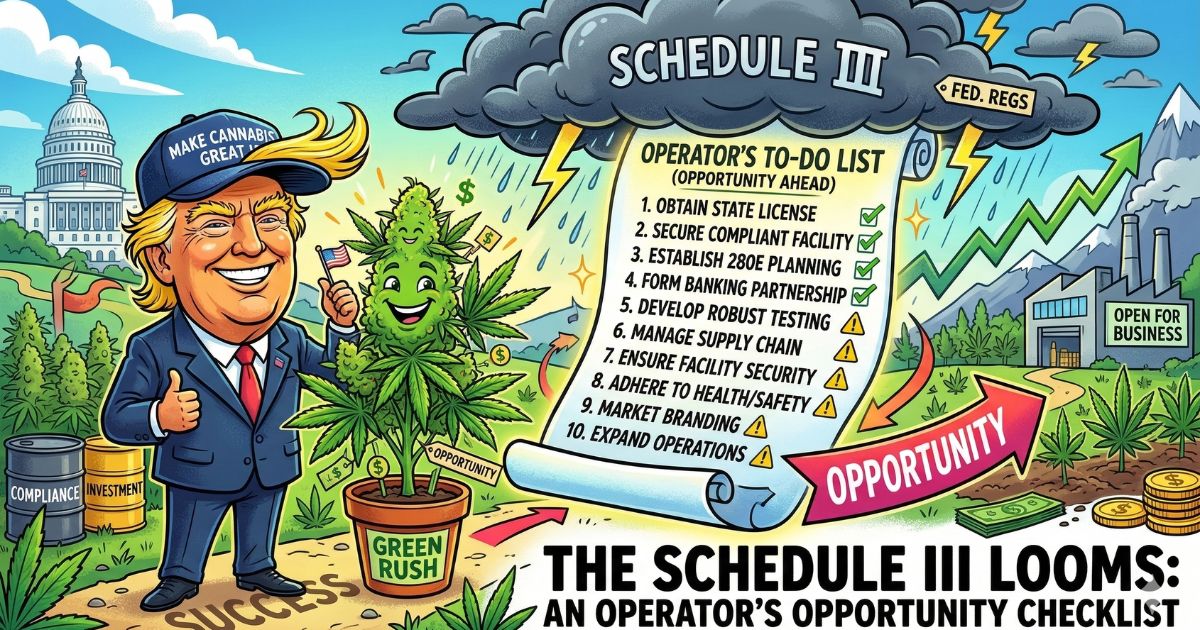
“The eyes of the world are upon you.” That line always felt less like a warning and more like a checklist. Because moments of transition are when the real work begins. The potential move of marijuana to Schedule III is one of those moments. It is not a celebration. It is a work order.
Over the past several months, I wrote a three part deep dive in my columns for Forbes on the legal, operational, and financial impacts of Schedule III. If you cannot sleep one night and want to truly understand where this industry is going, those pieces are worth the time.
Part I:
Trump And U.S. Cannabis Rescheduling: The Compliance Reality For Existing Operators
Part II:
Trump And Cannabis Rescheduling: Opportunities And Limitations Under Schedule III
Part III:
Trump, Cannabis Re- Or De-Scheduling And What Comes After
But here is the core takeaway. Schedule III will not unify this industry. Schedule III will create a divide. A real one. A structural one. And it is coming faster than many operators realize. Re you ready for this?
On one side will be companies that choose to become Schedule III registrants or the functional equivalent. These businesses will step into federal law. They will build systems capable of withstanding inspection, audit, and scrutiny. They will sell only to other registrants, qualified researchers, and potentially international licensees who operate within controlled narcotics and pharmaceutical frameworks.
On the other side will be companies that continue to operate exclusively under state law. These businesses will sell cannabis that is federally classified as Schedule III but without federal registration or compliance. State programs will not disappear. Adult use markets will not disappear. Medical cannabis in the United States has largely functioned as a legal qualification model rather than a fully integrated medical framework, and that distinction will remain.
These two systems will exist side by side unless there is federal de-scheduling, which is not on the horizon in any meaningful way. So the real question is not what the government will do. The real question is what you will do.
Are you preparing to become a compliant Schedule III operator, or are you preparing to remain a state based seller of a federally controlled substance.
Because this is not theoretical. And there will not be an entirely new rulebook waiting for you. If rescheduling occurs, the federal government will rely largely on existing controlled substance regulations. There will be litigation. Administrative delay. Procedural friction. But once the rule takes effect, operators will be expected to function within the current regulatory architecture.
That means the time to prepare is now.
The companies that understand this are already moving. Quietly. Deliberately. They are not waiting for clarity. They are building optionality.
They are walking their facilities with a different lens. Not asking whether they meet current state requirements, but whether those same facilities could withstand pharmaceutical scrutiny. They are evaluating environmental controls, data integrity, documentation culture, and validation protocols. They are studying what it would take to reach true pharmaceutical alignment, whether at a USP grade or even active pharmaceutical ingredient level. They understand that these are not construction projects. They are organizational transformations.
They are also studying regulatory pathways that did not matter before. Controlled substance registration. Drug master files. Clinical collaboration. Compounding strategies. Some are exploring whether they could supply compounding pharmacies. Others are asking whether they could become one. These pathways may not be fully accessible today, but they could become viable quickly in a Schedule III environment.
At the same time, sophisticated operators are beginning to understand supply constraints. Controlled substances operate within global treaty frameworks and national allocation systems. Production is not simply a function of demand. It is a function of quota, oversight, and policy. Those who understand these dynamics will price risk differently. Those who do not will be surprised.
Capital is also repositioning. When uncertainty narrows, liquidity moves. Relief from 280E will not just improve margins. It will reshape balance sheets. Secondary lending, refinancing, and structured capital will follow. Investors will move toward operators who demonstrate regulatory credibility and governance maturity. That means clean financials, transparent ownership, and defensible compliance cultures. It means boards that understand oversight in a regulated pharmaceutical environment.
Trust will become currency. Compliance trust. Financial trust. Institutional trust. CTrust, if you will. The companies that build it early will have the lowest cost of capital and the greatest strategic flexibility.
There is also a global dimension. U.S. operators must study international medical markets, not because they will immediately export, but because those systems provide a blueprint. They represent the operating model toward which federal expectations will likely converge. They also represent future competitors.
Yet even as this transition unfolds, consumer cannabinoid markets will not disappear. Hemp derived cannabinoids, particularly beverages and functional products, will remain essential for brand building and scale. The future will likely involve dual track strategies. Pharmaceutical alignment on one side. Consumer wellness and lifestyle on the other.
This is the divide. It is coming. And it will define capital, governance, and survival.
It is said that the best kitchens succeed because they prepare before the rush. They sharpen their knives before the orders arrive. This industry has been improvising for decades. Schedule III introduces structure.
And structure rewards preparation.
So ask yourself again. Which side will you be on? Are you ready. Because the wheel is turning and you cannot slow down. The companies that treat this moment as a work order will define the next era. The rest will spend it reacting.

Referred to by many as the Cannsigliere, Bob Hoban has been a pioneering force in the cannabis industry for over 16 years, shaping policy, business strategy, and legal frameworks worldwide. Recognized by Forbes in 2022 as one of the top 42 cannabis industry power players, Bob has advised governments, businesses, and investors on the global cannabis market. Bob also serves as faculty at UNLV’s first-of-its-kind Cannabis Policy Institute. He is a Co-Founder of CTrust, the cannabis industry’s first and only credit rating and debt monitoring agency. Bob previously served on publicly-traded company, Glass House Brands’, Board of Directors.
As a leading commercial cannabis attorney for nearly 18 years (Hoban Law Group, Clark Hill), Bob has represented industry titans and developed strategies for market expansion and diversification. He has advised over 30 countries, 15 U.S. states, and numerous local governments on cannabis policy.
Bob has also developed cannabis curricula at multiple universities. He is also the host of The Hoban Minute podcast, which has produced 200+ episodes and won industry awards.
Today, Bob serves as a fractional Chief Strategy Officer/President for international cannabis supply companies through his consulting firm, Greenbridge Proven Strategies (GPS) and remains engaged by several international governments. He continues to influence the global cannabis industry through policy leadership, strategic consulting, and market innovation.
Website: www.BobHoban.com