

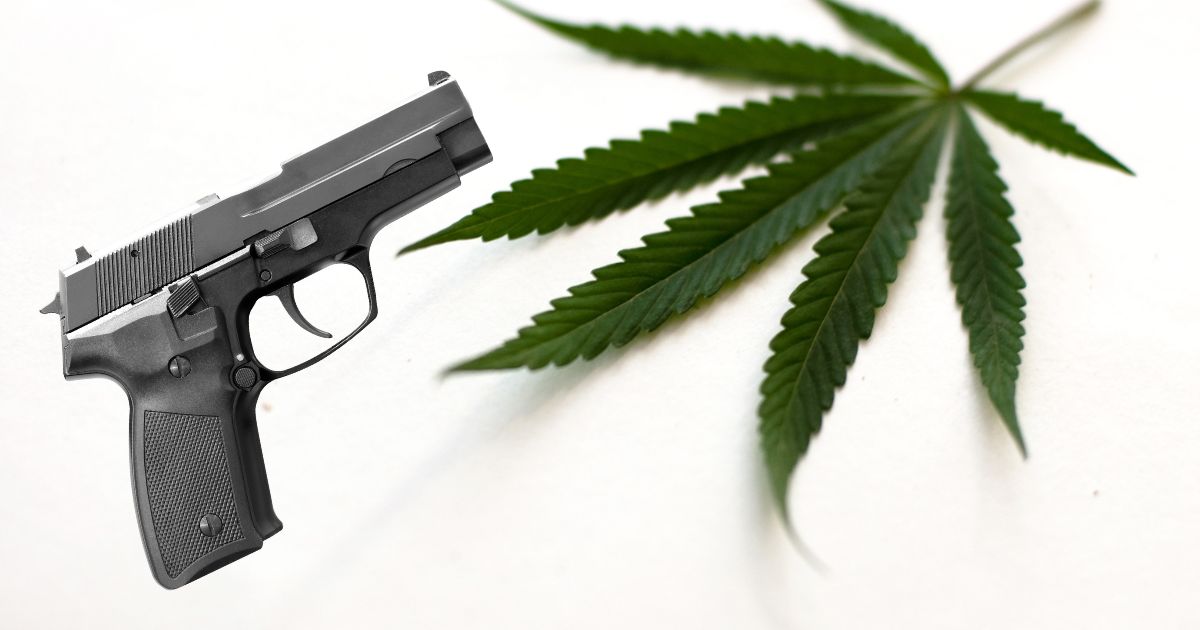



On March 2nd, the U.S. Supreme Court will hear oral arguments in one of the most significant cases for cannabis consumers in recent memory. This highly anticipated Supreme Court cannabis gun rights case, United States v. Hemani, asks a straightforward question with profound implications: Does federal law violate the Second Amendment when it strips Americans of their gun rights simply because they use marijuana?
At stake is more than just one defendant’s conviction. Millions of responsible cannabis consumers—many of them medical patients, veterans managing PTSD, and otherwise law-abiding citizens—currently face a choice between their medicine and their constitutional right to self-defense.
Case Against Ali Danial Hemani
Ali Danial Hemani was indicted in February 2023 for violating 18 U.S.C. § 922(g)(3), a federal statute that makes it a crime to possess firearms while being an “unlawful user of” a controlled substance. Federal agents found a 9mm pistol and marijuana at Hemani’s parents’ home during a search.
Critically, prosecutors never alleged that Hemani was intoxicated when he possessed the firearm, nor did they claim he posed any specific threat. His crime, in the eyes of the government, was simply being a regular marijuana user who happened to own a gun.
Hemani challenged the indictment on constitutional grounds. A federal magistrate judge sided with him, finding that the government lacked sufficient historical precedent—a key requirement under recent Supreme Court rulings—to prosecute him. The U.S. Court of Appeals for the Fifth Circuit agreed, affirming the dismissal and concluding that disarming marijuana users based solely on their status, rather than any dangerous conduct, violates the Second Amendment.
The Justice Department appealed, and the Supreme Court granted certiorari in October 2025. Now, the nation’s highest court will decide whether the federal government can continue to disarm cannabis consumers en masse.
Where the Law Stands Now
Federal law currently treats marijuana as a Schedule I controlled substance—the most restrictive classification, reserved for drugs deemed to have “high potential for abuse” and “no accepted medical use.” Anyone who uses marijuana, even occasionally, is considered an “unlawful user” under 922(g)(3) and is therefore prohibited from buying, owning, or possessing firearms.
This prohibition applies even in states where cannabis is fully legal for medical or recreational use. It doesn’t matter if you’re a cancer patient relying on cannabis for pain relief, a veteran using it to manage PTSD, or simply an adult who prefers cannabis over alcohol. If you consume marijuana—even a few times per week—federal law says you forfeit your Second Amendment rights.
The legal landscape began shifting after the Supreme Court’s 2022 decision in New York State Rifle & Pistol Association v. Bruen. In Bruen, the Court established that gun restrictions must be consistent with the nation’s historical tradition of firearm regulation.
The government can no longer simply assert a public safety interest; it must demonstrate that similar restrictions existed at the time of the Founding or, at minimum, during the period when the Second Amendment was ratified.
Building on Bruen, the Court ruled in 2024 in United States v. Rahimi that individuals found by a court to pose a credible threat to others can be temporarily disarmed without violating the Second Amendment.
However, the Rahimi case involved an individual who made explicit threats and was under a domestic violence restraining order—a far cry from a cannabis user who has never committed a violent act.
The Government’s Argument, Cannabis Users Are Dangerous?
In its most recent briefs to the Supreme Court, the Justice Department under Solicitor General D. John Sauer has doubled down on its position that marijuana users should be disarmed. The government argues that historical laws targeting “habitual drunkards” provide sufficient precedent for stripping gun rights from regular cannabis consumers.
According to DOJ, colonial-era vagrancy laws, civil commitment statutes, and surety laws all temporarily disarmed people deemed dangerous due to excessive alcohol use. These laws, the government claims, justify modern restrictions on cannabis users. The argument hinges on the idea that marijuana use—like habitual drunkenness—renders individuals categorically dangerous and unfit to possess firearms.
In its most recent filing, the government emphasized that marijuana would remain illegal under federal law, even if President Trump’s recent executive order leads to its reclassification from Schedule I to Schedule III.
DOJ emphasized that Schedule III drugs still have “a potential for abuse” and can “lead to moderate or low physical dependence or high psychological dependence.” The implication is clear: no matter how states or science view cannabis, the federal government believes users remain too dangerous to own guns.
The government also warned that reversing the Fifth Circuit’s ruling would lead to “mass disarmament” and chaos in federal gun enforcement. Solicitor General Sauer argued that since millions of Americans use opioids and cocaine, authorities cannot categorically disarm marijuana users without applying the same standard to other drug users.
This slippery slope argument suggests that any retreat from 922(g)(3) would undermine the entire federal framework for keeping guns away from substance users.
Defenders of Gun Rights and Cannabis Freedom Rally
On the other side, a coalition of unlikely allies has assembled to challenge the federal ban. One of the most surprising is the National Rifle Association (NRA), which filed an amicus brief alongside gun rights organizations and cannabis advocacy groups. The NRA’s involvement signals a significant shift in the politics of gun rights, as the organization has historically avoided taking positions that might alienate its more conservative base.
In its brief, the NRA argues that 922(g)(3) unconstitutionally punishes people for their status rather than their conduct. Historical laws, the NRA asserts, only disarmed individuals while they were actively intoxicated or engaged in dangerous behavior. No Founding-era law stripped sober citizens of their gun rights simply because they sometimes drank alcohol. The same principle, the NRA contends, should apply to marijuana.
The National Organization for the Reform of Marijuana Laws (NORML) also filed a brief, emphasizing the hypocrisy of federal policy. NORML pointed out that cannabis and hemp were common crops during the Founding Era.
Many of the Framers grew hemp, and there is zero evidence from the 18th or 19th centuries suggesting that cannabis use disqualified someone from owning firearms. NORML also highlighted that Congress currently protects state medical marijuana programs through annual spending bills, yet simultaneously argues in court that medical patients are too dangerous to exercise their Second Amendment rights.
Other organizations joining the fight include the Drug Policy Alliance, the Cato Institute, Gun Owners of America, the Second Amendment Foundation, and the Firearms Policy Coalition.
Together, these groups represent millions of Americans who believe that responsible cannabis use and responsible gun ownership are not mutually exclusive.
Why This Case Matters for Cannabis Consumers
The outcome of United States v. Hemani will have profound consequences for the cannabis community. Currently, anyone who uses marijuana—even occasionally—risks federal prosecution if they purchase or possess a firearm. This law has created a cruel dilemma for millions of Americans who want both to protect themselves and to use cannabis responsibly.
Medical marijuana patients are particularly affected. Veterans treating PTSD, cancer patients managing pain, and individuals with seizure disorders often face the impossible choice between their medicine and their safety. Current law effectively tells these patients: you can medicate, or you can defend your home, but you cannot do both.
The law also perpetuates the stigma that cannabis users are inherently irresponsible or dangerous. This outdated stereotype ignores decades of research showing that marijuana is far less impairing than alcohol and does not cause violent behavior. A ruling in favor of Hemani would help dismantle this stigma and affirm that cannabis consumers deserve equal treatment under the law.
Beyond individual rights, this case tests the limits of federal power in an era of rapidly changing cannabis policy. A majority of states have legalized marijuana in some form, and public support for legalization has never been higher.
If the Supreme Court sides with the government, it would affirm that federal prohibition can override state law and strip citizens of constitutional rights based solely on their choice to use a plant that most Americans believe should be legal.
A Coalition for Constitutional Rights
The alliance between gun rights advocates and cannabis reformers reflects a growing consensus that the drug war has overreached. When conservative organizations like the NRA agree with progressive drug policy reformers that federal prohibition infringes on constitutional liberties, it becomes clear that 922(g)(3) is indefensible.
This coalition argues that responsible cannabis use is no more disqualifying for gun ownership than responsible alcohol consumption. Just as we don’t presume someone who drinks beer with dinner is a danger to society, we shouldn’t presume someone who uses cannabis is dangerous either.
The key is conduct, not status. If a person is intoxicated and handling a firearm recklessly, that behavior can and should be prosecuted. But disarming all cannabis users categorically—including those who never touch a gun while impaired—goes far beyond what the Constitution allows.
What Happens Next?
Oral arguments are scheduled for March 2, 2026. During the hearing, the Justices will question attorneys for both sides, probing the strength of the government’s historical analogies and the scope of Second Amendment protections. A decision is expected by the end of June 2026.
If the Court rules in favor of Hemani and strikes down 922(g)(3) as applied to marijuana users, it would mark a historic victory for both gun rights and cannabis reform. Millions of Americans would no longer have to choose between their constitutional rights and their preferred method of relaxation or medication.
If the Court sides with the government, the federal ban would remain in place, continuing to criminalize cannabis consumers who own firearms. However, even a loss could create opportunities for future challenges, especially if the government reschedules marijuana and public opinion continues to shift.
The Path Forward For Cannabis Users and Gun Owners Rights
Regardless of how the Supreme Court rules, United States v. Hemani represents a turning point in the national conversation about cannabis and gun rights. The case forces the legal system to face the reality that cannabis use is widespread, socially accepted, and protected by state law in most of the country. It also highlights the absurdity of a federal policy that treats responsible cannabis consumers as second-class citizens.
For cannabis advocates, the message is clear: the fight for full legalization and equal rights is far from over. Even as states continue to reform their laws, federal prohibition remains a powerful barrier to justice.
The Supreme Court now has the opportunity to affirm that the Constitution protects cannabis users just as it protects everyone else. The question is whether the Justices will rise to the occasion—or whether they will allow an outdated federal ban to continue stripping millions of Americans of their rights.
- Supreme Court to Decide if Marijuana Users Can Own Guns
- 5th Circuit Appeals Court Declares Marijuana User Gun Ban Unconstitutional
- NRA Defends Cannabis Users’ Gun Rights in Supreme Court Showdown
- Justice Department Appeals Decision On Gun Rights Ban For Marijuana Consumers
- Federal Appeals Court Rules for Medical Marijuana Patients’ Gun Rights